AI estimate as of August 16, 2026 · verify with a professional before acting
AI-Generated · Verify before acting
Everything on this page is generated by AI for informational purposes only. AI can make mistakes — the AI may misidentify items or misattribute them (artist, maker, brand, designer, origin, era). This is not an official valuation and should not be used for insurance, sale, tax, estate, legal, or lending purposes — or any decision requiring a certified appraisal. It is not an authoritative claim about any person, brand, or rights holder — do not share or rely on it as a factual statement about a third party. Always consult qualified professionals before making financial decisions.
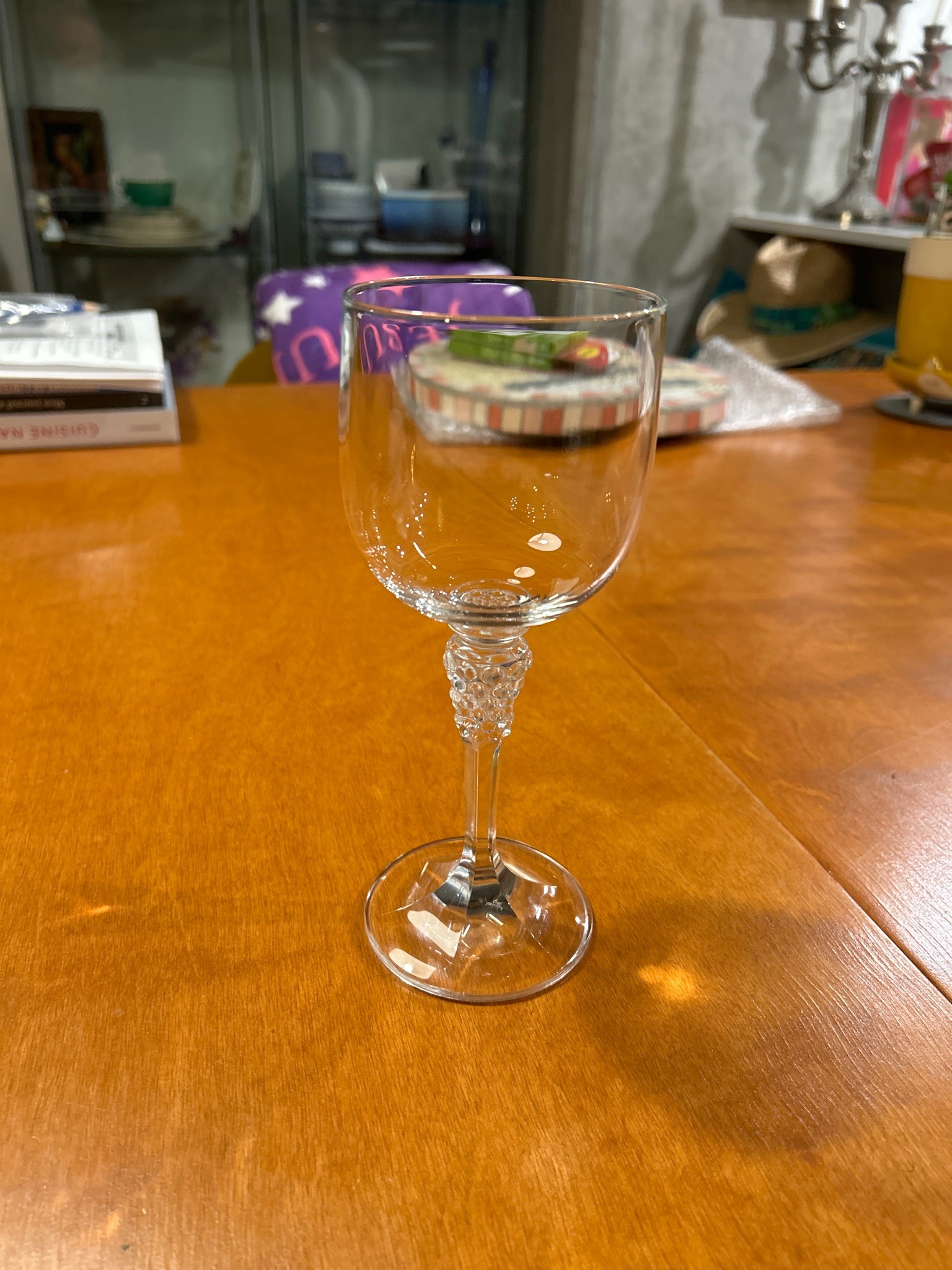
This is a single piece of clear glass stemware, likely intended as a wine glass or goblet, standing upright on a polished wooden dining table. The item features a smooth, rounded, tulip-shaped bowl connected to a slender stem. The most distinguishing physical characteristic is the decorative knop located near the top of the stem, just beneath the base of the bowl, which is textured with small, raised, bead-like or hobnail-style clear glass studs. The stem tapers down into a simple, flat, circular foot that provides stability. The glass is entirely clear, transparent, and colorless, showing no obvious cloudiness, discoloration, chips, or cracks from the angle observed in the photograph. There are no visible maker's marks, signatures, stamps, or etchings directly readable on the surface of the glass, meaning the identification is based purely on the physical form and decorative stem features rather than a specific brand attribution. The overall aesthetic is suggestive of mid-to-late 20th-century glassware production, featuring pressed or molded glass construction techniques typical of decorative tableware. The craftsmanship shows clean lines and clear material transparency, though microscopic quality indicators such as mold seams cannot be discerned without closer physical inspection. Because there are no visible hallmarks or labels, any specific maker or pattern remains unverified.
AI Appraisal Report
Based on what I can see in the photograph, this piece of clear glass stemware exhibits a tulip-shaped bowl and a distinctive textured hobnail-style knop on the stem, suggesting a mid-to-late 20th-century pressed glass production style. I can't verify from a photo the exact manufacturing technique, glass composition, or potential maker, as there are no visible hallmarks or signatures present. A physical inspection would need to be conducted to check for mold seams, weight, and clarity indicators that could point toward a specific manufacturer or era. The estimated value range of $25 to $50 reflects typical secondary market behavior for decorative vintage glassware of this type. This value assumes the aesthetic and form are representative of the period; however, if physical inspection reveals this to be a modern reproduction, replica, or mass-market copy 'in the style of' vintage tableware, the value would likely decrease to the $10-20 range. To establish a more precise attribution or evaluate any potential collectible significance, an in-person examination by a decorative arts expert would be required, along with a search for matching catalog patterns, as photographic analysis alone cannot rule out later reproductions.