These notes were written by the person who submitted this item. Appraiser.AI has not verified them, and the AI's identification and estimate may rely on them.
AI Estimated Value
Not an official valuation
$300 - $600
AI estimate as of September 2, 2025 · verify with a professional before acting
AI-Generated · Verify before acting
Everything on this page is generated by AI for informational purposes only. AI can make mistakes — the AI may misidentify items or misattribute them (artist, maker, brand, designer, origin, era). This is not an official valuation and should not be used for insurance, sale, tax, estate, legal, or lending purposes — or any decision requiring a certified appraisal. It is not an authoritative claim about any person, brand, or rights holder — do not share or rely on it as a factual statement about a third party. Always consult qualified professionals before making financial decisions.
This analysis also relies on unverified notes provided by the user, which may be incomplete or inaccurate and could affect the result.
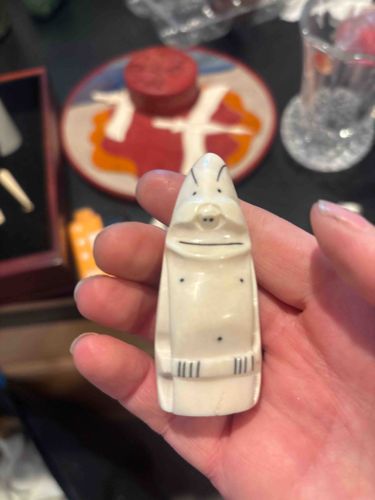
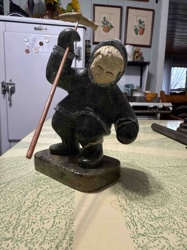
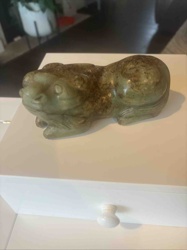
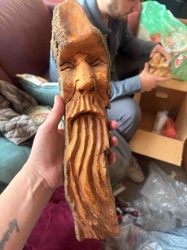
This item is a hand-carved, stylized figurative sculpture, likely crafted from ivory given the provided context. It measures approximately 3-4 inches in height, consistent with being held comfortably in an adult's hand. The material exhibits a smooth, polished finish with a creamy white to slightly yellowish hue, suggesting natural aging or patina. The form is elongated and somewhat teardrop-shaped at the top, tapering slightly towards a flat base. The carving depicts a stylized face at the upper portion, characterized by two small, dark dots for eyes, a diminutive, rounded protrusion for a nose with two small nostrils, and a simple horizontal line carved for the mouth. Above the eyes, there are two incised lines forming eyebrows or decorative facial markings, meeting at a point above the nose. The main body of the figure is minimalist, featuring two pairs of dark dots on the torso, possibly representing nipples or decorative elements. Below these, there is a distinct horizontal band, from which two sets of vertical parallel lines extend downward, resembling legs or a skirt. The craftsmanship appears to be folk art or tribal in style, with a somewhat crude yet expressive quality. There are no obvious signs of significant damage like chips or cracks, and the surface appears relatively clean. The precise age is difficult to determine without further information, but the material and style suggest it could be a 20th-century piece. No visible maker's marks or signatures are apparent in the image. The overall quality indicates skilled handwork, focusing on form and simplified features rather than intricate detail.
AI Appraisal Report
Upon my virtual examination of this carved figurative sculpture, I observe a piece consistent with hand-carved, stylized folk or tribal art. The material, described as ivory, displays the typical creamy white to yellowish hue and polished finish, suggesting genuine aged ivory. Its condition appears good, with no evident chips, cracks, or significant surface abrasions from the provided image. The simplistic yet expressive features indicate a focus on form over intricate detail, characteristic of many indigenous or folk traditions.
Market conditions for such pieces can vary. While genuine antique ivory commands higher prices, the described 20th-century folk art style would place it in a different segment. Comparable pieces of lesser known provenance or tribal affiliation tend to fall within a moderate range, especially if ethical sourcing documentation is not available. Demand exists among collectors of folk art, tribal art, and curiosities, but it's not a broadly high-demand market unless associated with a significant cultural group or well-documented artist. Rarity is difficult to assess without knowing the origin or carver; many similar stylized ivory carvings exist from various parts of the world.
Factors significantly impacting value include the actual age, precise origin (e.g., specific tribal affiliation), and whether it falls under any CITES regulations for ivory, which heavily restrict sale and transport. An in-person examination would be crucial for definitive authentication of the ivory, assessing tactile qualities and microscopic features. Provenance documentation (history of ownership, origin) would be invaluable for establishing authenticity and legal status. Scientific testing (e.g., carbon dating, spectroscopic analysis) could confirm age and material composition, drastically influencing its value and marketability.