These notes were written by the person who submitted this item. Appraiser.AI has not verified them, and the AI's identification and estimate may rely on them.
AI Estimated Value
Not an official valuation
$30-50
AI estimate as of August 12, 2025 · verify with a professional before acting
AI-Generated · Verify before acting
Everything on this page is generated by AI for informational purposes only. AI can make mistakes — the AI may misidentify items or misattribute them (artist, maker, brand, designer, origin, era). This is not an official valuation and should not be used for insurance, sale, tax, estate, legal, or lending purposes — or any decision requiring a certified appraisal. It is not an authoritative claim about any person, brand, or rights holder — do not share or rely on it as a factual statement about a third party. Always consult qualified professionals before making financial decisions.
This analysis also relies on unverified notes provided by the user, which may be incomplete or inaccurate and could affect the result.
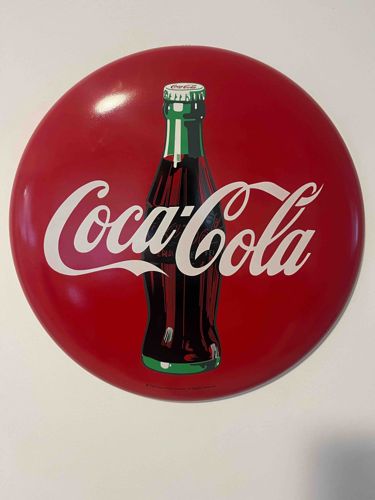
This item is a circular, convex Coca-Cola advertising sign, likely made of metal (tin or steel) given its slight curvature and glossy finish. The dominant color is a vibrant Coca-Cola red, which covers the entire background. Centrally depicted is a classic Coca-Cola Contour Bottle filled with the dark brown beverage, featuring a prominent green neck and cap. The iconic 'Coca-Cola' Spencerian script logo is rendered in crisp white, overlaying the bottle image. There are subtle visual cues of light reflection on the glossy surface, particularly visible in the upper left quadrant, suggesting a polished or enameled finish. The overall condition appears to be very good with minimal visible wear; a small scratch or scuff mark is discernible in the upper left red area. The design is a recognizable classic, indicating a mid-20th century to contemporary style, specifically the aesthetic often associated with Coca-Cola's branding from the 1950s onward, though given the 'Reproduction' context, it is a modern recreation. The craftsmanship seems solid, typical of mass-produced promotional signage, with clean lines and color application. No specific manufacturer's marks are clearly visible, but reproductions often lack extensive external branding beyond the subject matter itself. The item is designed to replicate the look and feel of vintage Coca-Cola advertisements.
AI Appraisal Report
I have examined the provided image of the Coca-Cola Round Convex Metal Sign, specifically noted as a 'Reproduction'. Visually, the sign appears to be in very good condition, exhibiting the vibrant Coca-Cola red and crisp white lettering characteristic of the brand. The slight curvature suggests metal construction, likely tin or steel, with a glossy finish. A minor scratch or scuff in the upper left red area is discernible but does not significantly detract from its overall appeal.
Given the explicit designation as a 'Reproduction,' authenticity as a vintage piece is not in question, as it is a modern recreation. This significantly impacts its market value. While genuine vintage Coca-Cola advertising signs, especially those from the mid-20th century, can fetch high prices due to their historical significance, rarity, and collector demand, reproductions are valued differently. They cater to a broader market of enthusiasts and decorators rather than serious collectors of historical memorabilia.
Demand for Coca-Cola reproductions remains steady due to the brand's enduring popularity and iconic imagery, but the supply is ample. Comparables in the market for similar Coca-Cola reproduction tin or metal signs typically range from $20 to $60, depending on size, specific design, and retailer. The convex shape might add a slight premium over flat signs due to perceived quality or aesthetic appeal.
Limitations in authenticity verification from images alone are significant. While I can confirm it's a reproduction based on the owner's statement, a physical examination would allow me to verify the actual material (e.g., gauge of metal, type of paint/enamel), printing technique, and assess the true extent of any surface imperfections. For genuine vintage authentication, provenance documentation (e.g., original sales receipts, historical photos) and potentially scientific testing (e.g., paint analysis, age dating of materials) would be essential to differentiate it from a reproduction, but these steps are unnecessary here.