AI estimate as of September 21, 2025 · verify with a professional before acting
AI-Generated · Verify before acting
Everything on this page is generated by AI for informational purposes only. AI can make mistakes — the AI may misidentify items or misattribute them (artist, maker, brand, designer, origin, era). This is not an official valuation and should not be used for insurance, sale, tax, estate, legal, or lending purposes — or any decision requiring a certified appraisal. It is not an authoritative claim about any person, brand, or rights holder — do not share or rely on it as a factual statement about a third party. Always consult qualified professionals before making financial decisions.
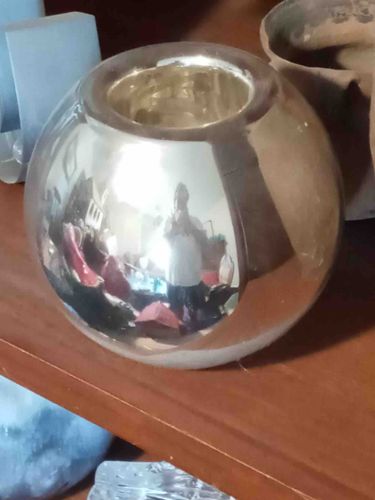
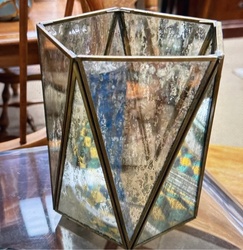
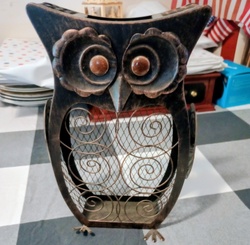
The item is a spherical candle holder crafted from glass, featuring an internal silvered finish that gives it a highly reflective, mirror-like exterior. It is predominantly silver in color due to this finish, with a slightly warmer, tarnished or aged appearance around the rim of the opening. The sphere has a smooth, unadorned surface. At the top, there is a circular opening, through which a candle (likely a tea light or small votive) would be placed. The inside of this opening also appears silvered, consistent with the exterior, though some internal reflections suggest a possible lighter or clearer glass underneath the silvering. The item appears to be of a moderate size, suitable for a tabletop or shelf display. There are no visible manufacturer's marks, signatures, or stamps in the provided image. The style suggests a modern or contemporary aesthetic, possibly mid-20th century to present day, focusing on sleek lines and reflective qualities. Its craftsmanship appears to be robust, typical of mass-produced decorative glassware, with good uniformity in its spherical shape. The reflective surface shows various surrounding environmental elements, including what appears to be a person taking the photo, which attests to its high reflectivity. There are no obvious chips, cracks, or significant damage, though the reflective surface makes precise condition assessment challenging. The slightly dulled or aged appearance of the silvering, particularly around the opening, could be a natural patina from age or handling, or it could be intentional.
AI Appraisal Report
I have examined the Silvered Glass Sphere Candle Holder presented through the provided image. Visually, the piece appears to be in good overall condition, with no overt chips, cracks, or significant breakage visible. The highly reflective surface, while a design feature, makes a precise assessment of minor surface abrasions or imperfections challenging from an image alone. The slight tarnishing or aged appearance around the rim could be either intentional or a natural patina, but it does not detract significantly from its aesthetic appeal for this style of item.
Authenticity, in this context, relates more to design contemporary origins. The style suggests a modern decorative piece, likely mass-produced. There are no maker's marks or identifying features, which is common for such items. Market conditions for items of this nature are generally stable but competitive. Comparables in the decorative home goods sector, particularly for new or gently used mirrored or silvered glass candle holders, typically range from $10 to $50, depending on size, brand, and retailer. This piece falls squarely within that aesthetic and functional category.
Demand for decorative pieces like this is consistent at the retail level for home staging or general décor. However, it lacks rarity; similar items are widely available. Factors impacting value are primarily its decorative appeal and condition. Without any provenance, unique design elements, or maker's marks, its value is as a generic decorative object.
Limitations in authenticity verification are significant due to the lack of physical examination. A hands-on inspection would allow me to assess the exact condition of the silvering, detect any subtle flaws in the glass, and determine the weight and overall craftsmanship more accurately. Scientific testing or provenance documentation wouldn't typically be necessary for an item of this type and value, as it is unlikely to be a collectible or a historic piece.