Handmade 16” round, 1” thick lazy Susan, signed by unknown artist
These notes were written by the person who submitted this item. Appraiser.AI has not verified them, and the AI's identification and estimate may rely on them.
AI Estimated Value
Not an official valuation
$450 - $650
AI estimate as of July 1, 2025 · verify with a professional before acting
AI-Generated · Verify before acting
Everything on this page is generated by AI for informational purposes only. AI can make mistakes — the AI may misidentify items or misattribute them (artist, maker, brand, designer, origin, era). This is not an official valuation and should not be used for insurance, sale, tax, estate, legal, or lending purposes — or any decision requiring a certified appraisal. It is not an authoritative claim about any person, brand, or rights holder — do not share or rely on it as a factual statement about a third party. Always consult qualified professionals before making financial decisions.
This analysis also relies on unverified notes provided by the user, which may be incomplete or inaccurate and could affect the result.
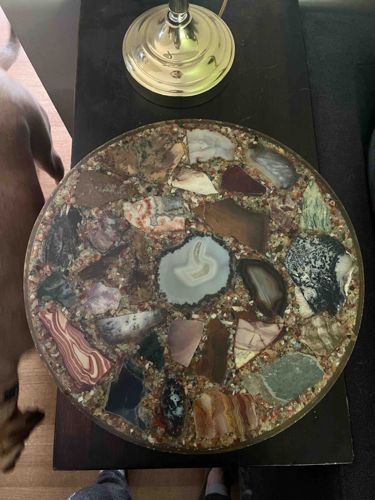
This is a handmade, circular lazy Susan measuring approximately 16 inches in diameter and 1 inch in thickness. The top surface is a captivating mosaic of various natural stone segments, meticulously embedded within a clear or slightly amber-tinted resin matrix. Dominating the design are irregularly shaped, polished slices of petrified wood, showcasing distinct wood grain patterns in shades of brown, red, and cream, along with numerous agate and geode slices exhibiting concentric banding, crystalline centers, and a diverse palette including grays, whites, browns, purples, and blues. A prominent central feature is a large, light grey and white banded agate slice. The interstitial spaces between the larger stone pieces are filled with smaller, crushed stone or gravel fragments, contributing to the earthy, organic texture of the piece. The resin surface appears highly polished and smooth, indicating a durable and well-finished top. While the base mechanism of the lazy Susan is not visible in the image, the overall construction suggests a robust and functional item. The craftsmanship appears high, with no obvious voids, bubbles, or damage visible on the resin surface, and the selection and arrangement of the natural stones demonstrate an artistic eye. Given the materials and construction, this piece likely belongs to a contemporary artisan style, possibly from the mid-20th century onward, and is confirmed to be signed by an unknown artist, adding to its unique, one-of-a-kind nature.
AI Appraisal Report
Upon visual examination of this artisanal lazy Susan, I am impressed by the quality of craftsmanship and the aesthetic selection of materials. The piece, measuring 16 inches in diameter, features a mosaic of high-quality petrified wood and agate segments, including striking geodes, set in a clear, well-polished resin. The composition is aesthetically pleasing, with a large central agate creating a strong focal point. The surface appears to be in excellent condition, with no visible cracks, significant scratches, or clouding in the resin.
The market for such unique, handcrafted natural stone decor is strong, particularly for items that blend functionality with artistic appeal. Similar resin and stone inlay pieces, often from the mid-century modern to contemporary periods, are popular. Comparables range from smaller, mass-produced items selling for under $200, to larger or artist-signed pieces fetching over $1,000.
The primary positive value driver is its unique, one-of-a-kind artisanal nature. The use of diverse and high-quality stone slices adds significant appeal. The fact that it is signed, even by an unknown artist, elevates it above generic factory-produced items. The main factor limiting a higher valuation is the anonymity of the maker; identifying the artist could substantially increase its value.
My appraisal is based solely on the provided images. A physical inspection would be required to assess the base mechanism's quality and condition, check for any repairs or hidden damages, and examine the signature more closely for potential identification. Final authentication would benefit from any provenance or sales records.