AI Appraisal Estimate

AI-generated estimates · not official valuations

From the user

What was submitted

Photo and notes provided by the user — not generated by AI

Submitted item photo
Submitted photo · June 20, 2026

User's notes

No additional notes provided.

AI analysis below

AI appraisal

AI analysis & estimate

AI-Generated · Verify before acting

Everything below is generated by AI for informational purposes only. AI can make mistakes — the AI may misidentify items or misattribute them (artist, maker, brand, designer, origin, era). This is not an official valuation and should not be used for insurance, sale, tax, estate, legal, or lending purposes — or any decision requiring a certified appraisal. It is not an authoritative claim about any person, brand, or rights holder — do not share or rely on it as a factual statement about a third party. Always consult qualified professionals before making financial decisions.

Read the full disclaimer

AI Identification

·Not independently authenticated·Verify before acting

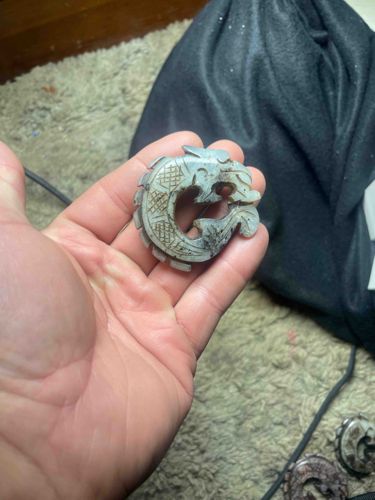
Carved Jade or Hardstone C-Dragon Pendant

Asian Art / Jewelry & Personal Ornaments

AI Estimated Value

·Not an official valuation·Verify before acting

$150 - $300

As of June 20, 2026

AI Item Analysis

·AI can make mistakes·Verify before acting
This item is a hand-carved pendant, likely made of jadeite, nephrite, or a similar green-gray hardstone, designed in the form of a 'C-shaped' dragon or 'zhülong' (pig dragon). It measures approximately 2 to 2.5 inches in diameter. The stone exhibits a mottled pale sage green and grey color palette with significant dark mineral inclusions and brownish calcification or 'chicken-bone' white weathering patterns, suggesting an intentional aged or archaic aesthetic. The carving features deep incised lines forming a cross-hatch or diamond-grid pattern along the body, representing scales, and fluted notches along the outer perimeter. The dragon's head is stylized with a large circular eye and a curved snout characteristic of Hongshan culture revival pieces. Regarding condition, there is visible surface wear, grime accumulation in the recessed carvings, and minor pitting on the edges. The overall craftsmanship shows traditional lapidary techniques with irregular hand-carved incisions rather than modern precision machining. While the style is Neolithic/Archaic, the surface patina suggests it may be a later 20th-century reproduction or 'archaistic' piece rather than a period artifact. No visible maker's marks or signatures are present, which is typical for this type of lapidary work.
AI Appraisal Report

·AI can make mistakes·Verify before acting
I have carefully examined the provided images of this C-shaped 'Pig Dragon' (zhulong) pendant. The piece measures approximately 2 to 2.5 inches and is carved from a mottled hardstone, likely a nephrite variant or similar silicate. The carving style and iconography are heavily influenced by Neolithic Hongshan culture. My visual inspection reveals deliberate 'archaistic' features, including brownish calcification and 'chicken-bone' weathering. However, the surface patina lacks the depth of true antiquity; the oxidation appears topical rather than emerging from the stone's crystalline structure. The mechanical consistency of the cross-hatch incisions suggests a 20th-century revival piece rather than a period artifact. The current market for Chinese lapidary art is highly bifurcated. Authentic Neolithic artifacts can command five and six-figure prices at major auction houses, whereas high-quality 20th-century 'study' pieces and decorative reproductions trade frequently in the low hundreds. This item lacks the necessary provenance or mineralogical indicators of a true antiquity, placing its value in the decorative 'collectible' category. Factors impacting value include the attractive mottling and the hand-carved nature of the notches, which offer better appeal than mass-produced resin casts. Limitations of this appraisal include the inability to perform a specific gravity test to identify the exact stone, or a microscopic examination of the bore-holes for rotary tool marks versus traditional abrasive sand abrasion. To elevate this valuation to 'Authentic Archaic' status, a physical inspection by a specialist in Chinese antiquities and carbon-dating of any organic matter in the pits, or TL testing of associated burial materials, would be required. Without documented provenance from a known historical collection, it is appraised as a modern archaistic pendant.

Get your items appraised

Instant estimates of your treasures with AI-powered appraisals

Browse More Appraisals