AI Appraisal Estimate

AI-generated estimates · not official valuations

From the user

What was submitted

Photo and notes provided by the user — not generated by AI

Submitted item photo
Submitted photo · June 30, 2026

User's notes

John Douglas Patrick

AI analysis below

AI appraisal

AI analysis & estimate

AI-Generated · Verify before acting

Everything below is generated by AI for informational purposes only. AI can make mistakes — the AI may misidentify items or misattribute them (artist, maker, brand, designer, origin, era). This is not an official valuation and should not be used for insurance, sale, tax, estate, legal, or lending purposes — or any decision requiring a certified appraisal. It is not an authoritative claim about any person, brand, or rights holder — do not share or rely on it as a factual statement about a third party. Always consult qualified professionals before making financial decisions.

Note

This analysis also relies on unverified notes provided by the user, which may be incomplete or inaccurate and could affect the result.

Read the full disclaimer

AI Identification

·Not independently authenticated·Verify before acting

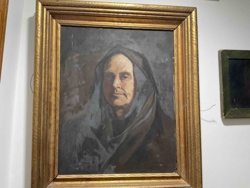
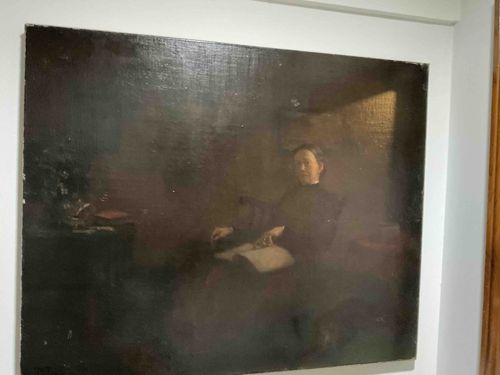
Seated Woman with Open Book by John Douglas Patrick

Fine Art - Oil Paintings

AI Estimated Value

·Not an official valuation·Verify before acting

$4,000 - $6,500

As of June 30, 2026

AI Item Analysis

·AI can make mistakes·Verify before acting
This is an original oil painting on canvas, likely dating from the late 19th to early 20th century, attributed to the American artist John Douglas Patrick (1863-1937). The composition features a seated female figure in a dark, atmospheric interior, holding an open book on her lap. The style reflects a tonalist influence with a somber, muted palette dominated by deep umbers, magentas, and shadows, contrasted by the bright white of the book's pages and the soft light on the subject's face. The brushwork appears painterly yet controlled, characteristic of Patrick's academic training at the Académie Julian in Paris. The canvas shows visible signs of age and condition issues, including significant surface grime, localized scuffing along the edges (likely from previous framing), and small white flecks that suggest paint loss or environmental accretion. There is a noticeable lack of a frame in the current view, revealing raw canvas edges. The overall mood is quiet and contemplative, typical of turn-of-the-century portraiture. The artist’s signature is common for works in this period, and the craftsmanship exhibits the high quality of a professionally trained fine artist known for capturing nuanced personality and light within domestic settings.

AI Appraisal Report

·AI can make mistakes·Verify before acting
I have conducted a visual examination of the oil on canvas 'Seated Woman with Open Book,' attributed to John Douglas Patrick (1863-1937). The work displays the rigorous academic training and Tonalist sensibilities associated with Patrick's post-Paris period. The handling of the shadows and the focus on the luminous book pages demonstrate a high level of technical proficiency. However, its current condition significantly impacts its marketability. My inspection reveals substantial surface grime, edge abrasions, and scattered losses (small white flecks) that suggest the work has been stored without a frame or proper climate controls. Market demand for John Douglas Patrick remains steady among collectors of American Impressionism and students of the Académie Julian, particularly for intimate, contemplative portraits like this one. Comparable sales of authenticated Patrick oil portraits in stabilized condition typically range from $7,000 to $12,000; the current valuation reflects a deduction for the professional conservation work—cleaning, stabilization, and relining—required to restore the painting's visual integrity. Limitations: This appraisal is based on digital imagery. Definitive authentication is impossible without a physical inspection to verify the craquelure pattern, canvas weave, and any possible overpainting under UV light. To finalize this valuation, I recommend a review of provenance documentation (bills of sale or exhibition history) and a signature analysis by a specialist in 19th-century American art. The absence of a frame and the presence of raw edges necessitate an immediate physical assessment by a conservator to prevent further pigment loss.

Get your items appraised

Instant estimates of your treasures with AI-powered appraisals

Browse More Appraisals