AI estimate as of September 3, 2025 · verify with a professional before acting
AI-Generated · Verify before acting
Everything on this page is generated by AI for informational purposes only. AI can make mistakes — the AI may misidentify items or misattribute them (artist, maker, brand, designer, origin, era). This is not an official valuation and should not be used for insurance, sale, tax, estate, legal, or lending purposes — or any decision requiring a certified appraisal. It is not an authoritative claim about any person, brand, or rights holder — do not share or rely on it as a factual statement about a third party. Always consult qualified professionals before making financial decisions.
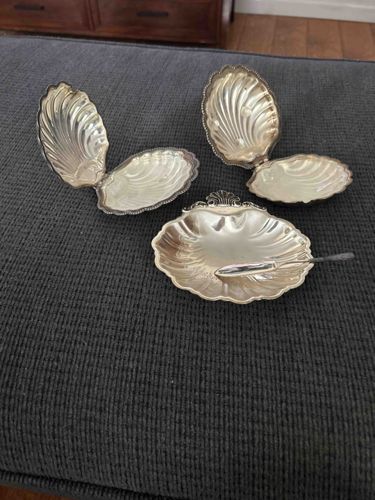
This lot consists of three ornate silver-toned items, likely made of sterling silver or silver-plated metal, designed to resemble clam or scallop shells. Two of the items are hinged containers, mimicking bivalve shells that open and close. Each half of these hinged shells features distinct ribbed detailing, emanating from the 'hinge' point, replicating the natural fluting found on certain seashells. The edges of both the hinged containers and the standalone dish are finished with a delicate, bead-like or rope-like border, adding to their decorative appeal. The third item is a single, open shell-shaped dish, larger than the individual halves of the hinged containers, and appears to be a serving piece. It also features the prominent ribbed design and the decorative border. There is a small, elongated, spoon-like implement resting in this larger dish, suggesting its use for serving condiments, salt, or small candies. The surfaces of all items exhibit a bright, polished silver luster, indicating either good care or recent cleaning. There are no immediately visible signs of heavy tarnish, dents, or significant scratching, suggesting a well-maintained condition. The craftsmanship appears to be of good quality, characterized by detailed molding and careful finishing, consistent with early to mid-20th century decorative tableware or vanity items. The presence of the small serving spoon within the larger dish implies a functional purpose beyond mere decoration. No specific maker's marks or signatures are visible in the provided image, which would be crucial for a precise appraisal.
AI Appraisal Report
Based on my visual examination of the provided image, this lot of three silver-toned shell-shaped items and a small spoon appears to be in very good condition. The bright, polished luster across all pieces, with no visible heavy tarnish, dents, or significant scratching, indicates either excellent care or recent thorough cleaning. The detailed ribbed design and the delicate bead-like or rope-like borders suggest good quality craftsmanship, consistent with decorative tableware from the early to mid-20th century. The presence of two hinged boxes and one open serving dish with a spoon adds to the versatility and decorative appeal of the set.
My assessment of authenticity is limited to visual cues. While the items *appear* to be sterling silver or good quality silver plate, I cannot definitively determine the metal composition without a direct physical examination, including non-invasive testing such as XRF analysis, or by locating and verifying any hallmarks. The lack of visible maker's marks is a significant factor in appraisal, as prominent manufacturers can significantly increase value.
In terms of market conditions, similar shell-shaped decorative items, particularly those in sterling silver, tend to command moderate collector interest. However, without confirmed sterling marks, these pieces would likely be valued as silver-plated items. Demand is generally stable for attractive, well-maintained vintage tableware, but these items are not inherently rare.
The primary factor impacting value here is the indeterminate metal composition and the absence of identifying marks. If these were confirmed as sterling silver by a known maker, the value would significantly increase. However, assuming them to be decorative silver plate, their value lies in their aesthetic appeal and good condition. For a full authentication, I would need a hands-on inspection to look for hallmarks, assess weight, and potentially conduct material testing. Provenance documentation, if available, would also be invaluable.