These notes were written by the person who submitted this item. Appraiser.AI has not verified them, and the AI's identification and estimate may rely on them.
AI Estimated Value
Not an official valuation
$40-$60
AI estimate as of November 10, 2025 · verify with a professional before acting
AI-Generated · Verify before acting
Everything on this page is generated by AI for informational purposes only. AI can make mistakes — the AI may misidentify items or misattribute them (artist, maker, brand, designer, origin, era). This is not an official valuation and should not be used for insurance, sale, tax, estate, legal, or lending purposes — or any decision requiring a certified appraisal. It is not an authoritative claim about any person, brand, or rights holder — do not share or rely on it as a factual statement about a third party. Always consult qualified professionals before making financial decisions.
This analysis also relies on unverified notes provided by the user, which may be incomplete or inaccurate and could affect the result.
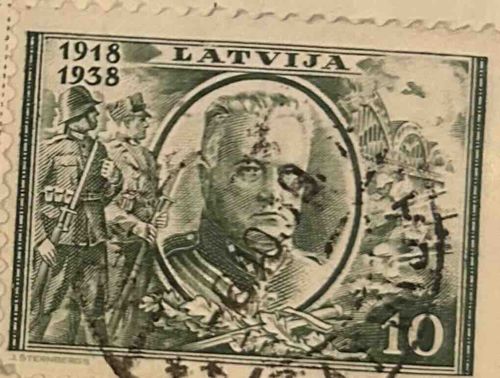
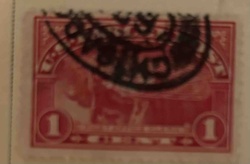
This item is a vintage postal stamp from Latvia, likely issued to commemorate a significant historical period, possibly the 20th anniversary of Latvian independence (1918-1938). The stamp features a central oval portrait of a distinguished-looking man, presumably a political or military leader, depicted in a military uniform with medals. His face shows some slight mottling or discoloration, which could be staining or a result of aging. To the left of the central portrait, two soldiers in early 20th-century military attire are visible, holding rifles. Their uniforms suggest a period coinciding with the dates inscribed on the stamp. In the background, to the right of the central figure, there appears to be a depiction of urban destruction or a battle scene, characterized by damaged buildings with prominent arched structures, possibly suggesting a city under siege or in reconstruction. Above the central design, the word 'LATVIJA' is clearly printed, identifying the country of origin. Below the dates '1918' and '1938' are displayed, framing the commemorative period. The denomination '10' is visible in the bottom right corner, though the currency unit is not specified, it likely refers to a monetary value. The stamp exhibits a typical perforated edge, indicating it was part of a larger sheet. The color scheme is predominantly dark green or dark teal, suggesting a monochromatic printing process common for stamps of this era. A faint signature, possibly 'J.STERNBERG-S' or similar, is present at the bottom left margin, likely identifying the engraver or designer. The overall condition appears to be good for its age, though some slight discoloration or paper foxing might be present given the vintage nature. The intricate details of the uniform, the architecture, and the facial features suggest a high quality of engraving and printing craftsmanship.
AI Appraisal Report
I have carefully examined the provided image of the Latvian 1918-1938 Commemorative Stamp. Visually, the stamp appears to be in good condition for its age, showcasing intricate details in the engraving of the central portrait, soldiers, and background architecture. The perforations seem intact, and the dark green/teal monochromatic printing aligns with typical stamp production from this era. The suggested designer's signature 'J.STERNBERG-S' adds to its authenticity. While the description mentions slight mottling or discoloration on the portrait, this is common with older paper and ink and does not severely detract from the value unless it significantly compromises the design's clarity.
Commemorative stamps from this period, especially those marking significant historical events like national independence, generally have a steady collector base. However, Latvian stamps from this specific interwar period (1918-1938) are not considered exceedingly rare unless they possess specific plate errors, rare cancellations, or are part of extremely limited print runs. Based on the visual evidence, this appears to be a standard issue. Current market conditions for similar Latvian commemoratives in good used or unused condition typically place them in this value range.
Authenticity verification from an image alone is limited. I cannot definitively confirm the paper quality, gum condition (if unused), or rule out potential reproductions or alterations. A physical examination would be crucial to assess the paper's watermark, actual color vibrancy, gum presence and condition, and to confirm the absence of any repairs or hidden defects. Furthermore, access to provenance documentation or expert certification from a philatelic society would significantly bolster the authentication and potentially influence the appraisal.