AI estimate as of November 8, 2025 · verify with a professional before acting
AI-Generated · Verify before acting
Everything on this page is generated by AI for informational purposes only. AI can make mistakes — the AI may misidentify items or misattribute them (artist, maker, brand, designer, origin, era). This is not an official valuation and should not be used for insurance, sale, tax, estate, legal, or lending purposes — or any decision requiring a certified appraisal. It is not an authoritative claim about any person, brand, or rights holder — do not share or rely on it as a factual statement about a third party. Always consult qualified professionals before making financial decisions.
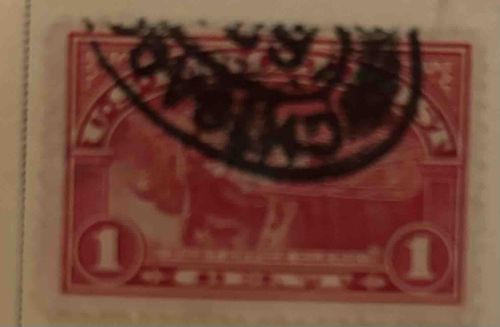
This item is a used, rectangular postal stamp primarily colored in shades of red, ranging from a vibrant crimson to a deeper maroon in certain areas due to lighting or printing variations. The stamp features a decorative border around its edges, possibly incorporating architectural or ornate design elements, though details are difficult to discern clearly due to the image resolution. In the lower left and lower right corners, there are prominent circular motifs, each containing the numeral '1' in white, indicating its denomination. The central image of the stamp is indistinct, but there appears to be a depiction of a building or a scene with structural elements within the main frame. Overlaid on the top portion of the stamp is a heavily inked, black postmark. This postmark is a significant feature, indicating the stamp has been used. The markings within the postmark are in a non-Latin script, possibly Arabic or a similar Middle Eastern language, and the shape suggests it might be a circular or oval cancellation mark that has been applied with some pressure and ink bleed. The condition of the stamp appears to be fair, given it is a used item. There are no immediately obvious tears or significant creases, but the edges seem slightly irregular, and the paper might show some age-related discoloration or typical wear from handling and use. The heavy postmark obscures a substantial portion of the upper design, which is a common characteristic of used stamps. The style suggests it could be a vintage or early 20th-century stamp, given the traditional design elements and the script of the cancellation.
AI Appraisal Report
Based on my visual examination of the provided image, this used red postal stamp with a '1' denomination appears to be in fair condition, consistent with a used item of its type. The heavy black postmark, with its non-Latin script (likely Arabic or similar), confirms its usage. While the design is somewhat obscured, the visible elements suggest a vintage or early 20th-century origin. The circular motifs with the numeral '1' are clear, and the overall integrity of the stamp seems acceptable, with no obvious tears or major creases. Authenticity, based solely on an image, is difficult to definitively confirm; however, there are no immediate red flags suggesting it is a modern forgery given its used state and the apparent age through wear.
Market conditions for common used stamps, even vintage ones, are generally modest unless they possess significant rarity, historical importance, or exceptional condition. The obscuring postmark, while authenticating usage, also diminishes visual appeal and value compared to a lightly cancelled or uncancelled example. Without knowing the exact country of origin or specific issue, it's challenging to pinpoint precise comparables, but similar 'first numeral' denomination stamps from the early 20th century, if common, typically trade in the low single to double-digit dollar range. Demand for general used foreign stamps is moderate. The rarity of this specific stamp cannot be determined from the image alone, but its used state and visible wear suggest it is not a high-value rarity.
To fully authenticate and precisely value this stamp, an in-person examination would be crucial. This would allow for detailed inspection of paper type, watermark (if any), printing method, precise perforation count, and color nuances. Provenance documentation, such as collection history or original purchase receipts, would also significantly aid in authentication. Finally, consulting specialized catalogs for stamps of the potential country of origin and era would be essential for definitive identification and market comparison.