AI estimate as of August 7, 2025 · verify with a professional before acting
AI-Generated · Verify before acting
Everything on this page is generated by AI for informational purposes only. AI can make mistakes — the AI may misidentify items or misattribute them (artist, maker, brand, designer, origin, era). This is not an official valuation and should not be used for insurance, sale, tax, estate, legal, or lending purposes — or any decision requiring a certified appraisal. It is not an authoritative claim about any person, brand, or rights holder — do not share or rely on it as a factual statement about a third party. Always consult qualified professionals before making financial decisions.
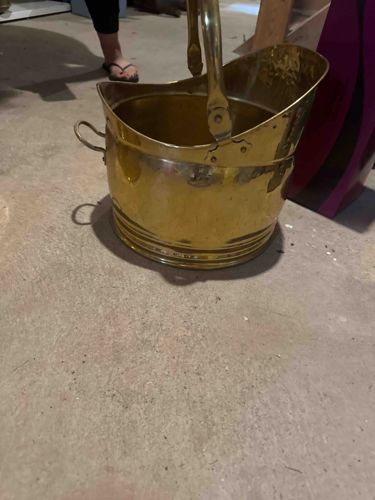
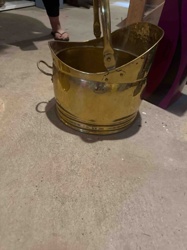
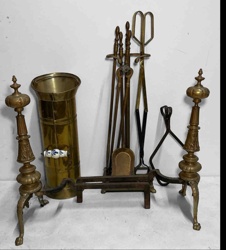
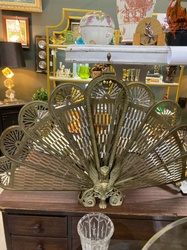
The item is a vintage or antique brass coal scuttle or bucket, likely used for holding coal or other fuel for a fireplace. It features a rich, aged brass patina, exhibiting variations in tone from a brighter gold to darker, tarnished areas, particularly in recesses and along seams, indicating its age and material authenticity. The scuttle has a distinctive D-shaped or kidney-bean shape, with one side higher than the other, forming a lip or spout for pouring. It is constructed from sheet brass, with visible seams and riveted construction, particularly where the handle attaches to the body.
The main handle is a sturdy, arched brass piece that swings freely, attached to the scuttle's upper edge with two riveted mounts. These mounts appear to be simple, functional brass plates. On the opposite side of the scuttle, near its base, there's a smaller, fixed loop handle, also D-shaped, allowing for easier tilting and pouring. The bottom of the scuttle features a raised, possibly reinforced, brass ring as a base. While no specific maker's marks or signatures are visible in the provided images, the robust construction and the style suggest it is a functional piece from the late 19th to early 20th century, consistent with Victorian or Edwardian era fireplace accessories. There are no obvious signs of major damage such as dents or cracks, but the surface shows general wear consistent with its utilitarian purpose and age, including minor scratches and scuffs.
AI Appraisal Report
Upon examining the provided image of this brass coal scuttle, I assess its condition as good, consistent with its age and utilitarian purpose. The aged brass patina, with its variations in tone and tarnish, strongly indicates authenticity as a vintage or antique piece, likely late 19th to early 20th century (Victorian/Edwardian era). The construction, involving sheet brass with visible seams and riveted elements, aligns with period manufacturing techniques. The presence of both a main swinging handle and a fixed pouring handle enhances its functionality and aesthetic typical of such items. I see no major structural damage like large dents or cracks; however, minor surface wear, scuffs, and scratches are evident, which is expected for an object of this type and age. These surface imperfections do not significantly detract from its value but rather add to its character.
From a market perspective, vintage brass coal scuttles are a steady ولكن not exceptionally rare category within home decor and fireplace accessories. Demand is moderate, driven by collectors of antique housewares, those furnishing period homes, or individuals seeking decorative accent pieces. Comparable items of similar quality and age typically range from $150 to $300. Factors positively impacting value include the robust construction, the distinctive D-shaped design, and the appealing natural patina. However, the lack of a known maker's mark or unique decorative elements limits its top-tier collector value.
Limitations in authenticity verification based solely on images are important to note. While the visual cues strongly suggest period authenticity, an in-person examination would allow me to physically verify the material composition, inspect the integrity of the rivets and seams more closely, and detect any restoration or repairs not visible in photographs. Provenance documentation, such as original sales receipts or family history, would significantly enhance authentication and potentially value. Scientific testing, like elemental analysis of the brass, could definitively confirm its age and composition, though this is rarely pursued for items in this price range.