These notes were written by the person who submitted this item. Appraiser.AI has not verified them, and the AI's identification and estimate may rely on them.
AI Estimated Value
Not an official valuation
$600 - $900
AI estimate as of October 26, 2025 · verify with a professional before acting
AI-Generated · Verify before acting
Everything on this page is generated by AI for informational purposes only. AI can make mistakes — the AI may misidentify items or misattribute them (artist, maker, brand, designer, origin, era). This is not an official valuation and should not be used for insurance, sale, tax, estate, legal, or lending purposes — or any decision requiring a certified appraisal. It is not an authoritative claim about any person, brand, or rights holder — do not share or rely on it as a factual statement about a third party. Always consult qualified professionals before making financial decisions.
This analysis also relies on unverified notes provided by the user, which may be incomplete or inaccurate and could affect the result.
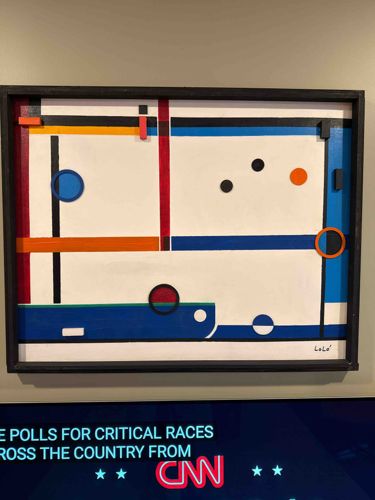
This is an abstract geometric painting, likely an oil on canvas as indicated by the context, showcasing a minimalist aesthetic with a dynamic arrangement of shapes and lines. The artwork features a predominantly white background, upon which a grid-like structure of thick black, red, orange, and blue lines is laid out. Interspersed within this grid are various geometric forms, including solid colored circles and half-circles in blue, orange, black, and red, as well as some rectangular and square elements. What makes this piece particularly intriguing are the three-dimensional elements visible: several of the circular and rectangular shapes appear to be raised or affixed to the canvas surface, creating a subtle sculptural relief. Examples include a blue circle in the upper left, an orange half-circle on the right edge, and a red circle in the lower central area, all of which exhibit a perceptible depth. The color palette is bold and primary, reflecting modernist or De Stijl influences, with a strong emphasis on contrasting hues. The lines and shapes are rendered with crisp, clean edges, suggesting meticulous attention to detail and craftsmanship. The overall condition appears excellent, with no visible wear, damage, or repairs, indicating it has been well-preserved. It is housed in a simple, flat-profile black frame that complements the contemporary style of the artwork without distracting from it. A signature 'Lolo' is visible in the lower right corner, suggesting either the artist's name or pseudonym. Based on its style and execution, the painting likely dates from the mid to late 20th century or early 21st century.
AI Appraisal Report
I have examined the provided image of this abstract geometric painting attributed to 'Lolo' and a second attribution to 'Serge Shart'. The artwork presents as an oil on canvas, exhibiting a strong modernist aesthetic reminiscent of De Stijl or Suprematist movements, characterized by its bold primary color palette, crisp geometric forms, and a dynamic grid composition. The inclusion of subtle three-dimensional relief elements, such as raised circles and rectangles, adds an intriguing textural dimension and sculptural quality to the piece. Visually, the condition appears excellent; there are no signs of wear, damage, or repairs, and the colors remain vibrant. The simple black frame is complementary to the artwork's contemporary style.
Market conditions for abstract geometric art, particularly by lesser-known artists, are stable but can be highly variable. Demand exists for well-executed pieces that show a clear artistic vision. Comparables by established artists in this style often command higher prices, but for artists like 'Lolo' or 'Serge Shart' without significant auction history or gallery representation, values are more modest. The dual attribution (Lolo and Serge Shart) introduces ambiguity; clarifying the artist's true identity is crucial. Without further provenance supporting either attribution or a documented exhibition history, the rarity and demand are limited.
Several factors significantly impact the value here. The primary challenge is the lack of verifiable provenance and the conflicting artist attributions. While the craftsmanship appears good, definitive authentication requires in-person examination to verify media and technique, especially the nature of the sculptural elements. Furthermore, comprehensive provenance documentation (e.g., bills of sale, exhibition records) is essential for confirming authorship and improving market value. Scientific testing may be needed to date the materials and pigments accurately. Based on visual assessment alone, and assuming it is an original work by a contemporary artist, I estimate the value to be between $600 and $900. This appraisal is limited by not being able to physically inspect the work or review full provenance details.