AI estimate as of August 3, 2025 · verify with a professional before acting
AI-Generated · Verify before acting
Everything on this page is generated by AI for informational purposes only. AI can make mistakes — the AI may misidentify items or misattribute them (artist, maker, brand, designer, origin, era). This is not an official valuation and should not be used for insurance, sale, tax, estate, legal, or lending purposes — or any decision requiring a certified appraisal. It is not an authoritative claim about any person, brand, or rights holder — do not share or rely on it as a factual statement about a third party. Always consult qualified professionals before making financial decisions.
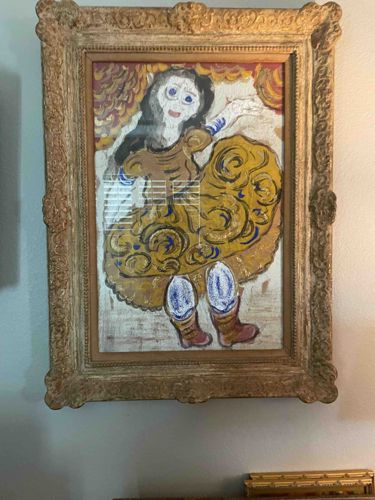
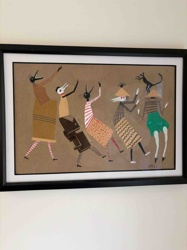
This item is a framed folk art painting depicting a whimsical, stylized female figure. The painting is executed in what appears to be acrylic or oil paints on a light-colored ground, possibly canvas or board. The central figure has a pale, almost white face with large, round blue eyes, a small red mouth, and black hair. She wears a brown or gold-colored garment with a large, ruffled skirt that dominates the lower half of the composition, rendered in a bright yellow-gold with swirling blue accents. Her arms are raised, with one arm extending to the viewer's left and showing blue stripes on the sleeve. The figure's legs are visible below the skirt, adorned with blue and white patterned socks or leggings and reddish-brown boots. The background suggests a stage or draped setting, with red and gold curtain-like elements at the top. The brushwork is expressive and somewhat unrefined, characteristic of folk art, with visible impasto in areas. The painting is housed within a substantial, ornate gold-tone frame with rococo-inspired scrolling and floral motifs at the corners and along the edges. The frame exhibits a distressed or aged finish, adding to its character. The visible condition includes what appear to be reflections from window blinds across the glazed surface, making it difficult to assess paint condition perfectly. However, there are no immediately obvious signs of damage such as cracks, flaking, or significant losses to the paint surface. The frame itself appears structurally sound, with some minor wear consistent with age and handling. No discernible artist's signature or maker's marks are visible in the provided image. Based on the style, the piece likely dates from the mid to late 20th century to early 21st century.
AI Appraisal Report
I have examined the image of this framed folk art painting. The piece depicts a whimsical female figure with expressive brushwork, characteristic of folk art. The medium appears to be acrylic or oil, on a light-colored ground. The condition, based purely on the image, seems good; I detect no obvious flaking, cracks, or significant losses to the paint surface, though reflections obscure a perfect assessment. The ornate gold-tone frame appears structurally sound with age-consistent wear. Authenticity as a 'folk art painting' is supported by its stylistic elements, which align with the genre's typical features of naive composition and vibrant, direct expression. However, without a signature or provenance, pinpointing a specific artist or precise origin is impossible.
In terms of market conditions, folk art continues to have a niche but dedicated collector base. Pieces with strong narratives, unique character, and good condition tend to perform well. Comparable sales for unsigned, decorative folk art pieces of this scale typically range from a few hundred to over a thousand dollars, depending heavily on aesthetic appeal and the 'charm' factor, which this piece possesses. While not rare in the broader sense of folk art, an individual piece like this is unique. The major value drivers are its decorative appeal, charming subject matter, and apparent good condition.
Limitations in authenticity verification from an image are significant. A full in-person examination would be critical to confirm the medium, assess the true condition of the paint surface and frame without reflections, and search for hidden signatures or marks. Provenance documentation (e.g., prior ownership, exhibition history) would be invaluable for establishing a more definitive history and potential artist attribution, thereby significantly impacting value. Scientific testing (e.g., pigment analysis, dating of materials) could provide more precise age verification.