AI Appraisal Estimate

AI-generated estimates · not official valuations

From the user

What was submitted

Photo and notes provided by the user — not generated by AI

Submitted item photo
Submitted photo · June 27, 2026

User's notes

No additional notes provided.

AI analysis below

AI appraisal

AI analysis & estimate

AI-Generated · Verify before acting

Everything below is generated by AI for informational purposes only. AI can make mistakes — the AI may misidentify items or misattribute them (artist, maker, brand, designer, origin, era). This is not an official valuation and should not be used for insurance, sale, tax, estate, legal, or lending purposes — or any decision requiring a certified appraisal. It is not an authoritative claim about any person, brand, or rights holder — do not share or rely on it as a factual statement about a third party. Always consult qualified professionals before making financial decisions.

Read the full disclaimer

AI Identification

·Not independently authenticated·Verify before acting

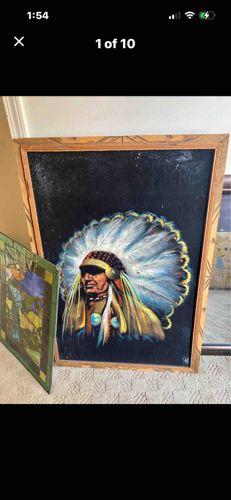
Vintage Black Velvet Painting of a Native American Chief

Fine Art / Vintage Collectibles

AI Estimated Value

·Not an official valuation·Verify before acting

$125.00 - $225.00

As of June 27, 2026

AI Item Analysis

·AI can make mistakes·Verify before acting
This is a large, vertical-oriented painting executed on black velvet fabric, a medium that gained significant popularity in mid-20th-century decorative art. The piece depicts a stylized portrait of a Native American Chief in profile, wearing an elaborate feathered headdress. The feathers are rendered using a bright palette of white, blue, and yellow highlights that contrast sharply against the deep black background. The figure's face is painted in warm copper tones with dark detailing, featuring a focused expression. He wears a beaded headband and visible jewelry, including what appears to be turquoise-colored ornaments. The painting is housed in a distinctive wooden frame that features etched or pyrography geometric patterns—likely sunbursts or zig-zags—which complement the Southwestern aesthetic. Such works were commonly produced from the 1960s through the 1970s, often as kitsch or souvenir art from the border regions of Mexico and the American Southwest. The condition appears fair based on the image, with some visible lint or dust particles on the velvet surface, which is a common issue for this substrate. The wooden frame shows minor scuffing and signs of age, consistent with a vintage item. No artist signature is clearly visible in the provided image, suggesting this may be a commercial decorative piece from an anonymous studio worker.

AI Appraisal Report

·AI can make mistakes·Verify before acting
Based on my visual examination of this vintage black velvet painting, I have determined it to be a commercial decorative work typical of the late 1960s or 1970s. The piece demonstrates the high-contrast aesthetic popularized in the border regions of the American Southwest. The use of vibrant cyan and yellow pigments against the light-absorbent velvet substrate creates a dramatic, kitsch appeal. The frame, featuring pyrography geometric motifs, is a significant value-add, as it elevates the piece above standard mass-market examples. The condition is fair; however, the velvet exhibits typical particulate accumulation (lint/dust) which, if not cleaned professionally, can permanently mar the fibers. Market demand for velvet art has seen a resurgence among 'Mid-Century Modern' and 'Tiki' collectors, though anonymous studio works remain affordable. The lack of a signature suggests a production-style origin rather than a known velvet master like Edgar Leeteg. Factors limiting the value include the commonality of the subject matter and the minor scuffing on the frame. It is important to note that this appraisal is based on digital images alone. Authentication of the pigments (to check for lead or specific period chemical compositions) and a physical search for a hidden signature on the stretcher bars would be required for a definitive valuation. I cannot determine the stability of the paint-to-fabric bond or the presence of hidden mold without a physical inspection. Provenance documentation, such as original gallery tags or purchase receipts from the 1970s, would further solidify its vintage status.

Get your items appraised

Instant estimates of your treasures with AI-powered appraisals

Browse More Appraisals