AI Appraisal Estimate

AI-generated estimates · not official valuations

From the user

What was submitted

Photo and notes provided by the user — not generated by AI

Submitted item photo
Submitted photo · June 17, 2026

User's notes

No additional notes provided.

AI analysis below

AI appraisal

AI analysis & estimate

AI-Generated · Verify before acting

Everything below is generated by AI for informational purposes only. AI can make mistakes — the AI may misidentify items or misattribute them (artist, maker, brand, designer, origin, era). This is not an official valuation and should not be used for insurance, sale, tax, estate, legal, or lending purposes — or any decision requiring a certified appraisal. It is not an authoritative claim about any person, brand, or rights holder — do not share or rely on it as a factual statement about a third party. Always consult qualified professionals before making financial decisions.

Read the full disclaimer

AI Identification

·Not independently authenticated·Verify before acting

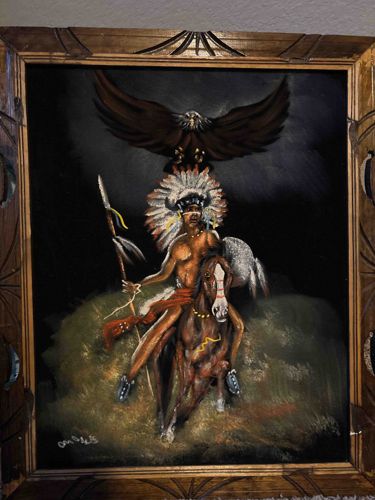
Native American Warrior on Horseback Velvet Painting

Fine Art / Vintage Collectibles

AI Estimated Value

·Not an official valuation·Verify before acting

$150-$250

As of June 17, 2026

AI Item Analysis

·AI can make mistakes·Verify before acting
This is a vintage black velvet painting depicting a Native American warrior mounted on a brown horse, with a large bald eagle soaring directly above him against a dark background. The central figure wears a large feathered war bonnet and holds a coup stick or spear adorned with feathers. The horse features white markings on its head and appears to be in motion atop a grassy mound rendered in earthy greens and browns. The painting is housed in a distinctive, wide wooden frame that features intricate carved or etched geometric starburst and crescent moon patterns, indicating a folk-art or mid-20th-century aesthetic typically seen in the 1960s or 70s. A signature is visible in the lower-left corner, though the name is stylized and difficult to decipher without closer inspection. Regarding condition, there is visible wear to the frame, including scuffing and small chips at the corners and along the inner edge. The velvet surface shows typical dust accumulation and a slight loss of fiber density in the upper dark regions. The use of vibrant, high-contrast pigments on the absorbent fabric is a hallmark of this genre, aimed at achieving a luminous, dramatic effect under localized lighting.

AI Appraisal Report

·AI can make mistakes·Verify before acting
Upon visual examination of this vintage black velvet painting, I find it to be a classic example of mid-to-late 20th-century folk-pop art, likely originating from the 1970s. The work features a Native American warrior motif, a popular subject during the 'velvet renaissance' period. The execution displays competent use of the textile’s absorbent properties to create high-contrast luminosity, particularly in the war bonnet and eagle’s plumage. The frame is a significant asset; the hand-carved geometric moon and star motifs suggest a curated pairing or a higher-tier commercial offering from the era, rather than a basic stock frame. Condition-wise, the velvet shows standard age-related thinning in the negative space and visible dust accumulation, which can affect the 'deep black' aesthetic. The frame exhibits notable scuffing and minor corner chips that detract slightly from the display value but confirm its vintage age. The signature, though stylized, appears consistent with professional artisans operating in the Tijuana or Southwestern U.S. studio circuits of that time. Market demand for velvet paintings has shifted from kitsch to 'vintage cool,' though values remain modest unless the artist is a known master like Leeteg. Comparables for framed indigenous-themed velvet works typically fall within the $100 to $300 range at auction. Factors limiting the value include the commonality of the subject matter and the noted frame damage. Important Limitation: This appraisal is based on digital images alone. A physical inspection is required to check for fabric rot, mold, or odors. To fully authenticate the piece and potentially increase its value, provenance documentation regarding the artist's studio or original purchase location would be necessary. Scientific testing of pigments could confirm the exact decade of manufacture, though it is rarely cost-effective for this genre.

Get your items appraised

Instant estimates of your treasures with AI-powered appraisals

Browse More Appraisals