AI estimate as of November 8, 2025 · verify with a professional before acting
AI-Generated · Verify before acting
Everything on this page is generated by AI for informational purposes only. AI can make mistakes — the AI may misidentify items or misattribute them (artist, maker, brand, designer, origin, era). This is not an official valuation and should not be used for insurance, sale, tax, estate, legal, or lending purposes — or any decision requiring a certified appraisal. It is not an authoritative claim about any person, brand, or rights holder — do not share or rely on it as a factual statement about a third party. Always consult qualified professionals before making financial decisions.
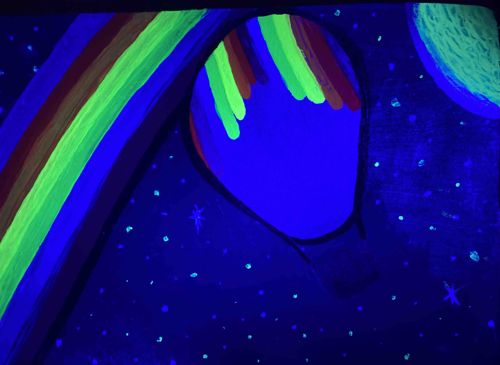
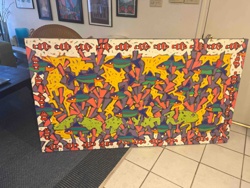
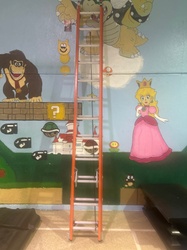
This appears to be a mural or painting, likely painted directly onto a wall or a large canvas, designed to be viewed under blacklight or UV illumination. The dominant colors in visible light would likely be different, but under blacklight, the piece exhibits striking fluorescent hues. The central motif is a large, vibrant blue hot air balloon, detailed with fluorescent red, orange, yellow, and green stripes on its upper portion, suggesting the vibrant colors typical of a hot air balloon's canopy. The balloon's basket or gondola is depicted in a darker, less luminous hue, possibly dark gray or black in regular light, but appearing as a shadow under blacklight. To the left and curving across the top, a large rainbow arch is visible, created with fluorescent green, blue, and red stripes. The background is a deep, dark blue, mimicking a night sky or outer space, dotted with numerous small, glowing 'stars' and larger, star-shaped elements, primarily in luminous blues and greens. In the upper right quadrant, a circular form, possibly a planet or moon, is depicted with a textured, luminous green surface. The painting technique appears to be somewhat stylized and possibly naive or folk art influenced, with broad brushstrokes and clear, defined areas of color. The overall condition appears good, with no discernible damage or significant wear under the blacklight view, emphasizing the inherent glow of the fluorescent pigments. The quality of craftsmanship seems competent, especially in the application of blacklight-reactive paints which are known for their distinct visual impact.
AI Appraisal Report
Upon visual examination of this 'Hot Air Balloon and Rainbow Mural' under blacklight, I observe a charming and vibrant piece utilizing fluorescent pigments. The condition appears good, with no visible damage or significant pigment loss, suggesting careful handling or recent creation. The authenticity, purely from this image, points to it being a genuine blacklight-reactive artwork, likely a mural or large canvas painting. This is based on the consistent fluorescent glow and stylistic choices apparent under UV light.
Market conditions for blacklight art are somewhat niche but there is a consistent, if smaller, demand. Comparables would include other folk art or psychedelic-influenced murals designed for specific lighting conditions. The value is primarily driven by its decorative appeal and the unique visual experience it offers in a blacklight environment. Demand is limited to those seeking such a specific aesthetic, and while it exhibits creative use of color, the artistic execution appears competent rather than master-level, suggesting a more decorative rather than fine art valuation. Rarity is difficult to assess; while this specific composition may be unique, the genre of blacklight art is not.
Factors impacting value include its good condition and the successful application of fluorescent paints. However, the lack of a known artist, provenance, or exhibition history limits its collectibility. Without a physical inspection, accurate assessment of pigment type, substrate, and age is impossible. An in-person examination would allow for tactile inspection of the surface, assessment of the medium's stability, and potential identification of artists' signatures or production details. Provenance documentation would be crucial to verifying authorship and history, and scientific testing could confirm pigment composition and age more precisely. Based on the visual information alone, this is a well-executed decorative piece within its specific medium.