These notes were written by the person who submitted this item. Appraiser.AI has not verified them, and the AI's identification and estimate may rely on them.
AI Estimated Value
Not an official valuation
$400 - $800
AI estimate as of August 15, 2026 · verify with a professional before acting
AI-Generated · Verify before acting
Everything on this page is generated by AI for informational purposes only. AI can make mistakes — the AI may misidentify items or misattribute them (artist, maker, brand, designer, origin, era). This is not an official valuation and should not be used for insurance, sale, tax, estate, legal, or lending purposes — or any decision requiring a certified appraisal. It is not an authoritative claim about any person, brand, or rights holder — do not share or rely on it as a factual statement about a third party. Always consult qualified professionals before making financial decisions.
This analysis also relies on unverified notes provided by the user, which may be incomplete or inaccurate and could affect the result.
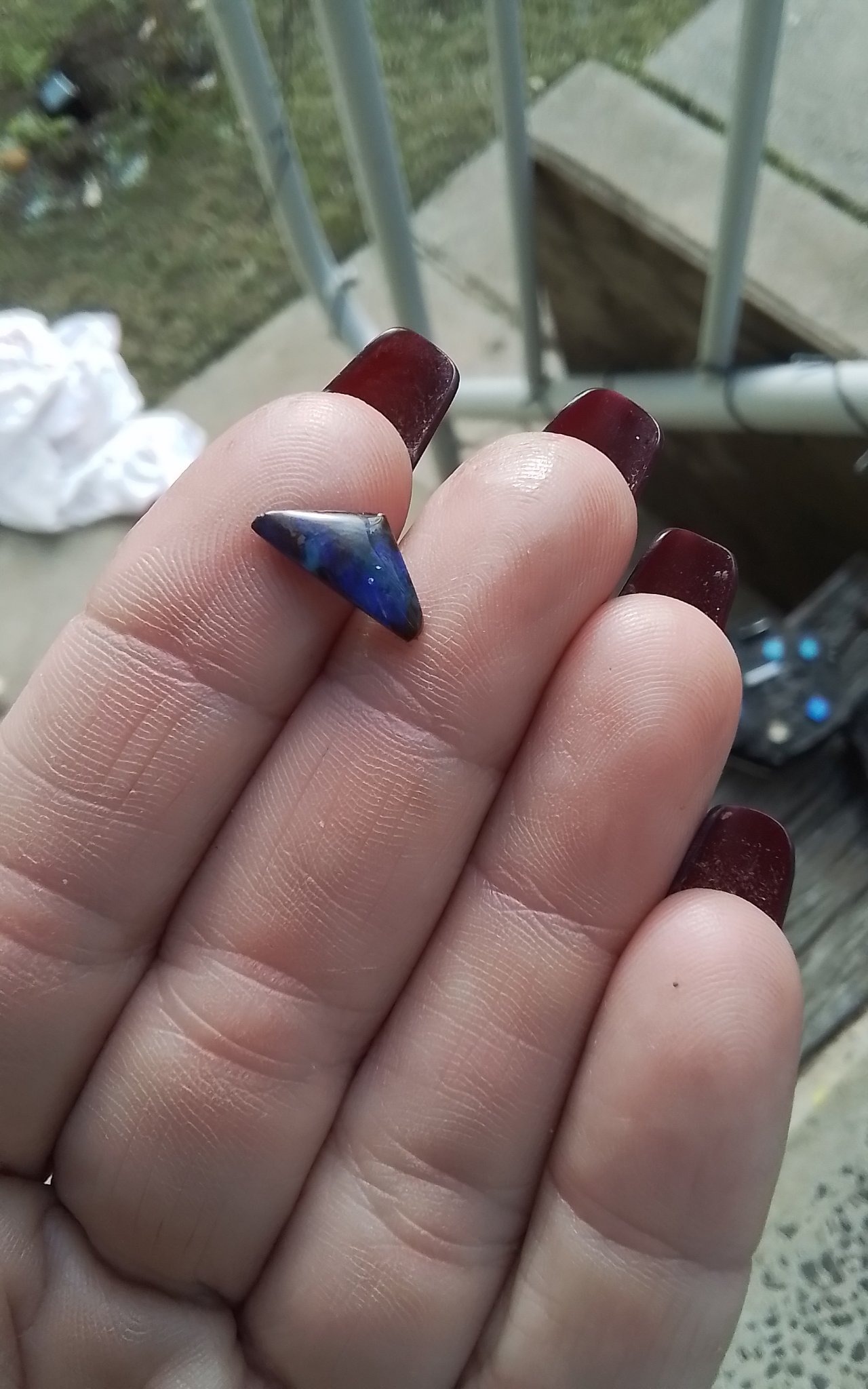
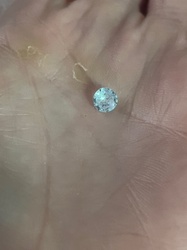
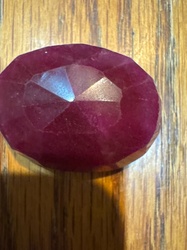
The item is a small, loose, triangular-shaped gemstone held resting on a person's fingers for scale. Based on visual characteristics, the stone appears to be an opal, displaying a dark body tone with play-of-color flashes predominantly in hues of blue, violet, and dark green. The cut is a distinct irregular triangle or trillion shape, featuring a polished surface and a domed cabochon top profile typical for display gemstones. There are no visible maker's marks, hallmarks, or inscriptions present on the visible surfaces of the stone, which is expected for loose gem material. The identification rests purely on the optical play-of-color and surface characteristics visible in the photograph; physical gemstone testing such as refractive index measurement or specific gravity testing would be required to verify the material identity. The owner has provided additional context with the note '1.8ct', which implies a weight claim of 1.8 carats, though this user-supplied specification remains entirely unauthenticated and unverified by physical scale measurement in this appraisal. The item's condition appears smooth and polished overall with no immediately obvious major fractures visible from this single angle, though micro-abrasions cannot be ruled out without microscopic examination. The gemstone exhibits qualities consistent with natural boulder opal or black opal types featuring a dark matrix, but laboratory gemological analysis is necessary to determine natural versus synthetic origin or any treatments.
AI Appraisal Report
Based on what I can see in the photograph, I observe a loose, triangular-shaped gemstone resting on fingers for scale, displaying a dark body tone with play-of-color flashes primarily in blue, violet, and dark green. Per user submission, the item is claimed to weigh 1.8 carats and is hypothesized to be an opal, though I cannot verify material identity, weight, or natural versus synthetic origin from a photo alone. Based on these visual characteristics and assuming the owner's unauthenticated specifications are correct, comparable loose opal gemstones of this general size and play-of-color typically trade within the $400 to $800 range in current secondary markets, depending heavily on brilliance, pattern rarity, and lack of internal fractures. However, this estimate is entirely conditional. Physical gemstone testing, including refractive index measurement, specific gravity testing, and microscopic examination for treatments or synthetic matrix composition, would be needed to confirm material identity. If the item turns out to be a synthetic opal, a simulant, or a lower-quality assembly rather than a natural solid opal, the market value would drop significantly, likely to the $50 to $150 range. Without in-person gemological analysis, this valuation remains an unverified estimate dependent on the accuracy of the owner's claims.