These notes were written by the person who submitted this item. Appraiser.AI has not verified them, and the AI's identification and estimate may rely on them.
AI Estimated Value
Not an official valuation
$15,000 - $35,000
AI estimate as of October 24, 2026 · verify with a professional before acting
AI-Generated · Verify before acting
Everything on this page is generated by AI for informational purposes only. AI can make mistakes — the AI may misidentify items or misattribute them (artist, maker, brand, designer, origin, era). This is not an official valuation and should not be used for insurance, sale, tax, estate, legal, or lending purposes — or any decision requiring a certified appraisal. It is not an authoritative claim about any person, brand, or rights holder — do not share or rely on it as a factual statement about a third party. Always consult qualified professionals before making financial decisions.
This analysis also relies on unverified notes provided by the user, which may be incomplete or inaccurate and could affect the result.
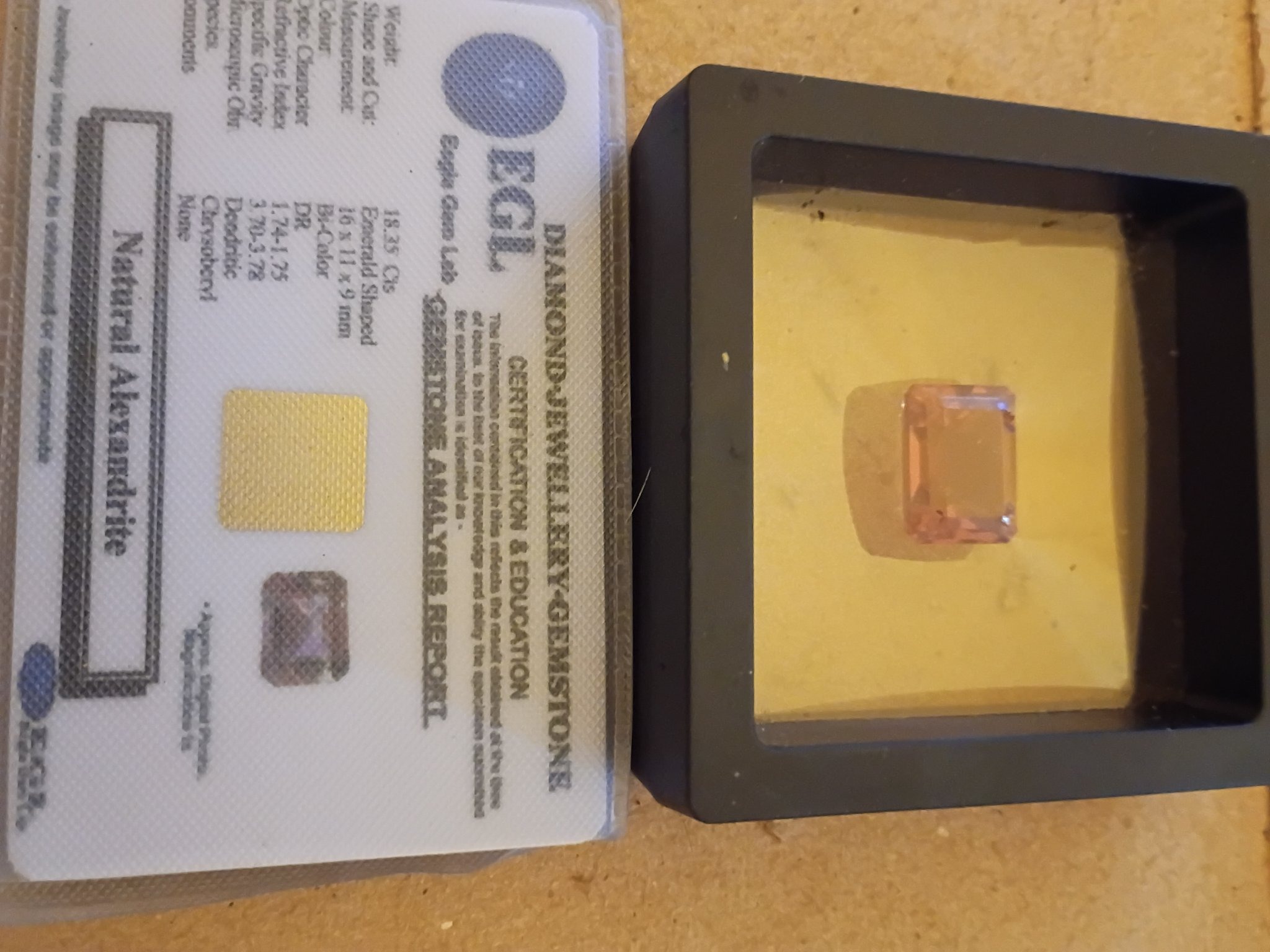
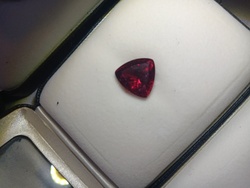
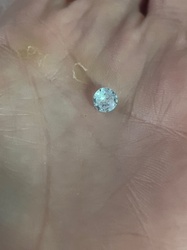
The item presented is a faceted, rectangular emerald-cut loose gemstone resting inside a dark display box with a light-colored interior pad. Accompanying the stone is an accompanying laminated document titled 'DIAMOND-JEWELLERY-GEMSTONE CERTIFICATION & EDUCATION' from 'Eagle Gem Lab' (EGL). The document lists specifications including an estimated weight of 18.35 carats, an emerald shape and cut measuring approximately 16 x 11 x 9 mm, a bi-color description, a refractive index of 1.74-1.75, specific gravity of 3.70-3.78, and identifies the material as 'Chrysoberyl' with a final typed label reading 'Natural Alexandrite'. The stone exhibits a brownish-pink or yellowish-pink hue in the provided photograph, though optical color-change properties cannot be fully assessed or verified from a single static image alone. The accompanying document and user-supplied notes claim the material is an alexandrite gemstone weighing approximately 18 carats; however, laboratory reports and user claims are unverified by physical inspection, gemological testing, or instrumental analysis. The identification rests strictly on the accompanying paperwork and visual presentation, both of which are unauthenticated. The physical condition of the stone appears clean with sharp facet junctions as visible through the packaging, but any definitive statements regarding natural origin, treatment status, or exact mineral species would require professional in-person gemological examination.
AI Appraisal Report
Based on what I can see in the photograph and the accompanying unauthenticated paperwork from Eagle Gem Lab, the item is presented as a faceted, rectangular emerald-cut loose gemstone weighing approximately 18.35 carats and identified as a natural alexandrite. I cannot verify from a photo whether the material is a natural alexandrite, a synthetic chrysoberyl, or another gemstone entirely, as optical color-change properties, inclusions, and specific physical constants cannot be evaluated from a single static image. My estimate assumes the user-supplied claim and laboratory document are correct regarding the identity and approximately 18-carat weight of the stone. If the attribution is correct and the stone is a natural alexandrite of substantial size and quality, comparable market behavior for large fine-color chrysoberyl alexandrites suggests a value range of $15,000 to $35,000, driven by rarity, size, and optical phenomena. However, if the stone turns out to be a synthetic laboratory-created alexandrite, a different mineral species, or a replica, the market value would drop dramatically, likely ranging from $200 to $800 depending on the material. To confirm the identity, treatment status, and natural origin, physical inspection, advanced gemological testing such as spectroscopic analysis, and formal certification from a recognized major laboratory like GIA or Gubelin would be required.