AI estimate as of November 11, 2025 · verify with a professional before acting
AI-Generated · Verify before acting
Everything on this page is generated by AI for informational purposes only. AI can make mistakes — the AI may misidentify items or misattribute them (artist, maker, brand, designer, origin, era). This is not an official valuation and should not be used for insurance, sale, tax, estate, legal, or lending purposes — or any decision requiring a certified appraisal. It is not an authoritative claim about any person, brand, or rights holder — do not share or rely on it as a factual statement about a third party. Always consult qualified professionals before making financial decisions.
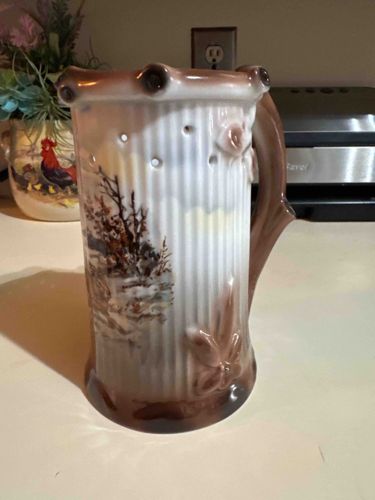
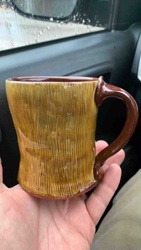
This item is a decorative ceramic tankard or mug, characterized by its ribbed body and an applied winter landscape scene. The main body of the vessel is off-white with distinct vertical ribs, interspersed with small, evenly spaced circular perforations that extend around the upper two-thirds of the mug. The bottom third of the mug, the handle, and the upper rim are glazed in a rich, glossy brown color, creating a striking contrast with the lighter body. The handle is C-shaped, robust, and smoothly integrated into the brown sections of the mug. A prominent feature is the hand-painted or decal application of a winter scene depicting snowy ground, bare trees with brown foliage accents, and possibly a hint of a building or structure in the background. The sky in the scene appears to have muted, cool tones, suggesting an overcast or early morning winter day. Additionally, there are raised, brown ceramic decorative elements, possibly in the shape of leaves or floral motifs, applied to the brown lower section of the mug, adding to its ornamental quality. The rim of the mug is also adorned with small, rounded brown protrusions, resembling knots on a branch, which may serve as both decoration and structural reinforcement. The overall style suggests an antique or vintage decorative piece, likely from the late 19th to early 20th century. The ceramic appears to be earthenware or stoneware, possibly with a majolica-like finish on the brown glazed areas. The condition appears good, with no immediately visible chips or cracks, although closer inspection would be needed to confirm any minor wear or crazing consistent with its age. The craftsmanship indicates a factory-produced item with decorative hand-finishing.
AI Appraisal Report
This ceramic tankard or mug presents as a decorative vintage item, likely late 19th to early 20th century, possibly German or Austrian in origin given the style often associated with Mettlach or similar factories. The ribbed off-white body with perforations, contrasting with the glossy brown glazed sections, is characteristic. The applied winter scene, while charming, appears to be a decaled or transfer-printed application rather than hand-painted, which is common for this type of production piece. The raised brown decorative elements further enhance its decorative appeal.
From the image, the condition appears good with no overt chips, cracks, or significant repair. However, without physical examination, I cannot confirm the absence of crazing, hairline cracks, or minor glaze losses which are common with age. Authenticity as a period decorative piece seems highly probable based on design and known production methods of the era; however, definitive authentication of origin or maker marks would require an in-person inspection of the base. Minor losses or condition issues in the applied decoration are also possible.
The market for decorative ceramic tankards of this nature is steady but not highly competitive. While attractive, it's not a rare piece from a top-tier maker, and similar items are periodically available through online marketplaces and antique shops. Demand is primarily from collectors of decorative ceramics or those seeking period-specific home decor. The primary drivers of value for this specific piece are its good apparent condition, decorative aesthetic, and vintage appeal. Without maker's marks or a compelling provenance, this will remain a decorative collectible item rather than a high-value rarity.
For full authentication and precise condition assessment, a direct physical examination is essential to inspect for maker's marks, specific glaze quality, internal condition, and any subtle damages not visible in photographs. Provenance documentation would also confirm its history.