These notes were written by the person who submitted this item. Appraiser.AI has not verified them, and the AI's identification and estimate may rely on them.
AI Estimated Value
Not an official valuation
$80-120
AI estimate as of August 27, 2025 · verify with a professional before acting
AI-Generated · Verify before acting
Everything on this page is generated by AI for informational purposes only. AI can make mistakes — the AI may misidentify items or misattribute them (artist, maker, brand, designer, origin, era). This is not an official valuation and should not be used for insurance, sale, tax, estate, legal, or lending purposes — or any decision requiring a certified appraisal. It is not an authoritative claim about any person, brand, or rights holder — do not share or rely on it as a factual statement about a third party. Always consult qualified professionals before making financial decisions.
This analysis also relies on unverified notes provided by the user, which may be incomplete or inaccurate and could affect the result.
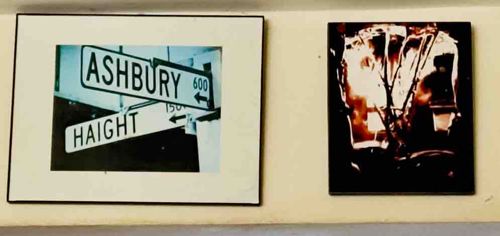
The image displays two distinct pieces of wall art mounted on a light-colored, possibly cream or pale yellow, wall. On the left is a framed photographic print featuring a stark, high-contrast image of two street signs: "ASHBURY" and "HAIGHT". The street names are rendered in white block letters on dark, likely green or black, backgrounds, with white arrows indicating directions and smaller numbers, possibly address ranges, visible. The photograph appears to be a black and white or sepia-toned image with a subtle blue tint, giving it a vintage or artistic feel. It is set within a simple, narrow black frame, and the matting surrounding the image is a light, perhaps off-white or cream, color. The overall condition of the first piece appears good, with no visible damage to the frame, mat, or print itself, suggesting it is well-preserved. There's what might be a slight reflection on the glass or a subtle texture in the print, indicative of its photographic nature.
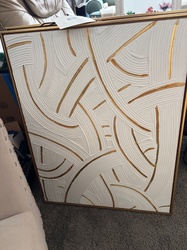
To the right, the second piece is a darker, abstract artwork, possibly a painting or a print, presented on what appears to be a black or very dark background. The central elements are irregular shapes of brown, tan, and reddish-orange hues, possibly depicting a chaotic scene or an abstract interpretation of natural forms like trees or roots. The lighter tones seem to emanate from within the darker areas, creating a sense of depth and contrast. The edges of this piece are sharp, suggesting it might be mounted on a rigid substrate like a canvas board or metal panel, without a traditional frame. The entire composition has a somewhat rough or distressed texture, possibly intentional, contributing to its abstract nature. The quality of craftsmanship for both pieces appears standard for mass-produced or decorative art, with the first piece showing clear photographic detail and the second featuring a distinct artistic style. There are no discernible maker's marks or signatures visible in the provided image. The style period for the photographic print suggests a contemporary reproduction of an iconic historical landmark, while the abstract piece is more broadly contemporary.
AI Appraisal Report
I have examined the provided image of the 'Haight-Ashbury Street Signs Framed Print' and the accompanying abstract art piece. The photographic print of the Haight-Ashbury street signs appears to be in very good condition, with no visible damage to the print, mat, or simple black frame. The subtle blue tint suggests a contemporary reproduction designed to evoke a vintage feel. The abstract piece on the right, displaying brown, tan, and reddish-orange hues on a dark background, also appears to be in good condition, with its intended rough or distressed texture intact. There are no visible maker's marks or signatures on either piece.
From a visual examination alone, confirming authenticity beyond 'decorative art' status is not possible. Physical inspection would be required to assess print quality (e.g., giclée vs. offset lithograph), paper type for the print, and the medium and substrate of the abstract piece (e.g., canvas, board, or metal). Provenance documentation, such as purchase receipts or artist statements, would be crucial for attributing the abstract piece to a specific artist or confirming the print's edition or origin. Without such information, these pieces are evaluated as mass-produced or decorative wall art.
Market conditions for such decorative art are generally stable, with a broad supply of similar items available from home decor retailers, online art marketplaces, and discount stores. The iconic nature of the Haight-Ashbury signs adds some appeal, but without limited edition status or artist attribution, it remains a common decorative item. Demand for these types of pieces is consistent but not high-value driven. Rarity is low for both pieces in this category.
Valuation is primarily based on their decorative appeal and condition, rather than artistic merit or collectible value. The 'Hidden drawer puzzle box' information provided by the owner does not directly influence the appraisal of the wall art itself, as it appears to be a separate item not depicted.
Limitations: Authenticity verification is severely limited without in-person examination to assess physical characteristics, and provenance documentation.