These notes were written by the person who submitted this item. Appraiser.AI has not verified them, and the AI's identification and estimate may rely on them.
AI Estimated Value
Not an official valuation
$50 - $100
AI estimate as of October 17, 2025 · verify with a professional before acting
AI-Generated · Verify before acting
Everything on this page is generated by AI for informational purposes only. AI can make mistakes — the AI may misidentify items or misattribute them (artist, maker, brand, designer, origin, era). This is not an official valuation and should not be used for insurance, sale, tax, estate, legal, or lending purposes — or any decision requiring a certified appraisal. It is not an authoritative claim about any person, brand, or rights holder — do not share or rely on it as a factual statement about a third party. Always consult qualified professionals before making financial decisions.
This analysis also relies on unverified notes provided by the user, which may be incomplete or inaccurate and could affect the result.
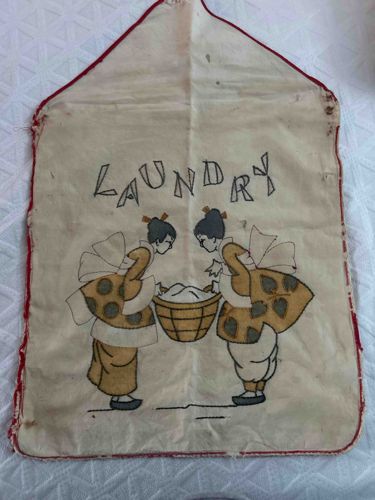
This item is a vintage laundry bag, likely designed to hang, given its tapered top and red-stitched edges. It is constructed from a cream-colored, somewhat coarse-textured textile, possibly cotton or a linen blend, which has yellowed and discolored with age. The overall shape is rectangular with the top portion narrowing to a point, creating a hanger-like silhouette. The edges are finished with a vibrant red, machine-stitched binding that appears to be original to the piece, though it shows some fraying and wear, particularly at the corners and along the upper edges. The most prominent feature is the central illustration, depicting two stylized figures, presumably women, dressed in what appears to be traditional Japanese or East Asian attire. They are shown with dark hair styled in buns, wearing kimonos or similar garments in shades of gold, cream, and olive green with darker polka-dot patterns. They are bending over a wicker-like basket filled with white laundry or suds. Above them, the word 'LAUNDRY' is stenciled or screen-printed in a somewhat crude, handwritten-style font in black. The design's aesthetic suggests a mid-20th century origin, possibly 1930s-1950s. The textile exhibits multiple signs of age and use, including numerous dark brown and gray stains scattered across its surface, consistent with dirt, mildew, or general grime accumulated over decades. There are also areas of discoloration and fading. The fabric itself shows some creasing and loss of crispness, indicating it has been laundered or handled extensively. The craftsmanship of the illustration is fairly simple, with a folk art or utilitarian charm rather than fine artistry. The stitching on the red binding is functional but not overly refined. The item's condition indicates it was actively used and is now in a well-loved, patinated state, which could be appealing to collectors of vintage textiles or Americana/Asianabilia.
AI Appraisal Report
Based on my examination of the provided image and description, this vintage Japanese-style laundry bag presents as an authentic mid-20th century textile. The cream-colored, coarse-textured fabric with its yellowing and discoloration, along with the red machine-stitched binding showing wear and fraying, are consistent with an item of its presumed age and practical function. The stylized depiction of two women in traditional attire and the 'LAUNDRY' stencil align with the folk art aesthetic common in utilitarian household items of the 1930s-1950s.
The condition, while well-loved and patinated, significantly impacts its value. Numerous dark brown and gray stains, along with general grime and fading, place it firmly in the 'fair to good' vintage condition category. While some collectors appreciate this 'used' aesthetic, it detracts from broader market appeal and monetary value.
The market for vintage utilitarian textiles is generally niche. Comparable items, such as vintage advertising textiles, feed sacks, or similar laundry bags, typically retail in the $30-$80 range, with exceptions for very rare or exceptionally well-preserved examples. The 'Japanese-style' imagery adds a unique decorative element, appealing to collectors of Asian-themed Americana or textile ephemera, slightly enhancing demand.
Rarity is moderate; while not a mass-produced collectible, similar items emerge periodically. The primary factors impacting value are its condition and its decorative appeal offsetting the wear.
Limitations in authenticity verification from images alone include the inability to physically inspect the fabric weave, determine fiber content, or analyze the printing technique up close. An in-person examination would allow me to better assess fabric integrity, identify the precise nature of the stains, and confirm the method of illustration. Scientific testing, such as dating threads or pigment analysis, would offer definitive authentication but is typically reserved for items of much higher value. Without physical inspection, I rely on visual cues and the description to infer age and authenticity.