AI Appraisal Estimate

AI-generated estimates · not official valuations

From the user

What was submitted

Photo and notes provided by the user — not generated by AI

Submitted item photo
Submitted photo · June 17, 2026

User's notes

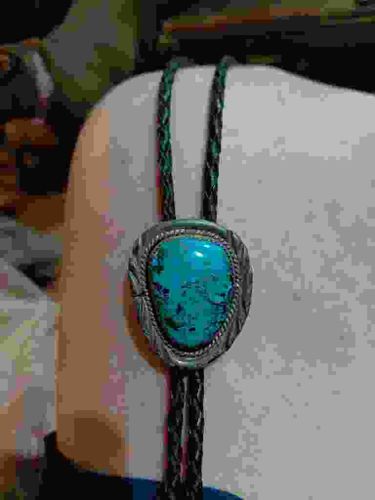
turquoise silver mid- century bolo

AI analysis below

AI appraisal

AI analysis & estimate

AI-Generated · Verify before acting

Everything below is generated by AI for informational purposes only. AI can make mistakes — the AI may misidentify items or misattribute them (artist, maker, brand, designer, origin, era). This is not an official valuation and should not be used for insurance, sale, tax, estate, legal, or lending purposes — or any decision requiring a certified appraisal. It is not an authoritative claim about any person, brand, or rights holder — do not share or rely on it as a factual statement about a third party. Always consult qualified professionals before making financial decisions.

Note

This analysis also relies on unverified notes provided by the user, which may be incomplete or inaccurate and could affect the result.

Read the full disclaimer

AI Identification

·Not independently authenticated·Verify before acting

Mid-Century Native American Turquoise and Sterling Silver Bolo Tie

Vintage Jewelry / Southwestern Native American Art

AI Estimated Value

·Not an official valuation·Verify before acting

$450 - $650

As of June 17, 2026

AI Item Analysis

·AI can make mistakes·Verify before acting
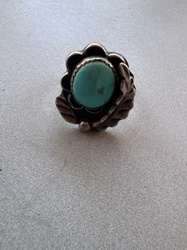
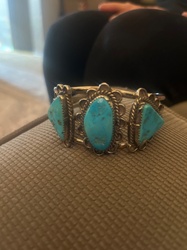
This is a vintage mid-century bolo tie featuring a high-domed, freeform natural turquoise cabochon set in a handcrafted sterling silver slide. The stone exhibits a vibrant cerulean to deep-sea-green hue with significant dark matrix inclusions, characteristic of southwestern mines such as Royston or Morenci. The turquoise is secure within a sawtooth bezel, which is surrounded by a twisted wire rope detail and a decorative outer frame featuring hand-stamped leaf or feather motifs. The silverwork shows a rich, dark oxidation in the recessed areas, highlighting the texture and aged patina typical of authentic vintage Navajo or Zuni craftsmanship. The slide measures approximately 1.5 to 2 inches in height and is attached to a traditional braided black leather cord. The leather shows signs of suppleness and minor surface wear consistent with age. While no hallmark is immediately visible on the front, the construction techniques—such as the hand-filed edges and manually twisted wire—point to a mid-20th-century artisan origin (circa 1950s-1970s). The overall condition is good, with some minor surface scratches on the silver and natural pitting within the stone, which does not appear to be stabilized. Such pieces are highly valued for their individual character and the quality of the vintage turquoise utilized.
AI Appraisal Report

·AI can make mistakes·Verify before acting
I have carefully examined the provided details and images for this Mid-Century Native American Bolo Tie. The piece demonstrates classic Navajo design elements from the mid-20th century, specifically the high-domed, hand-cut turquoise stone and the sawtooth bezel/twisted wire motif. The oxidation patina appears consistent with age, and the lack of a hallmark suggests a traditional artisan provenance often found in pieces prior to the mid-1970s. The stone displays characteristics associated with the Royston or Morenci mines; the presence of natural pitting and lack of 'plastic' sheen indicates a high probability of the turquoise being untreated/natural, which significantly enhances collector interest. The current market for 'Old Pawn' and vintage Southwestern jewelry remains strong, with increased demand for authentic natural-stone bolos. Comparable pieces of this size and era typically hammer for $400 to $700 depending on the specific mine identification. The absence of a signature slightly limits the high-end ceiling, though the quality of the stampwork and the substantial size of the cabochon maintain its desirability. Please note this appraisal is based on visual examination of the provided description and images. Authentic verification is limited without physical inspection; I cannot definitively confirm stone stabilization or silver purity (sterling vs. coin silver) without chemical testing. To establish full provenance and maximum valuation, an in-person examination would be required to analyze the solder points, tool marks under magnification, and any potential bench-marks on the reverse. Documentation regarding the specific estate or region of acquisition would further bolster its market position.

Get your items appraised

Instant estimates of your treasures with AI-powered appraisals

Browse More Appraisals