AI estimate as of September 27, 2025 · verify with a professional before acting
AI-Generated · Verify before acting
Everything on this page is generated by AI for informational purposes only. AI can make mistakes — the AI may misidentify items or misattribute them (artist, maker, brand, designer, origin, era). This is not an official valuation and should not be used for insurance, sale, tax, estate, legal, or lending purposes — or any decision requiring a certified appraisal. It is not an authoritative claim about any person, brand, or rights holder — do not share or rely on it as a factual statement about a third party. Always consult qualified professionals before making financial decisions.
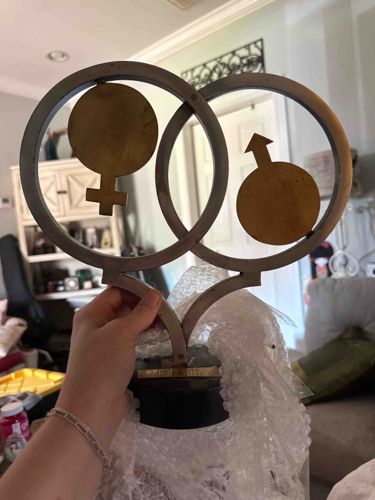
This item is a decorative display piece featuring two interlocked rings, each holding a distinct gender symbol. The left ring encloses the Venus symbol (♀), representing female, and the right ring encloses the Mars symbol (♂), representing male. Both gender symbols are crafted from a polished, brass-toned metal, suggesting a material like brass or a brass-plated alloy, exhibiting a warm, slightly dulled golden hue indicating some age and potential patina. The rings themselves appear to be made from a different metal, possibly aluminum or a lighter-toned brushed steel, showcasing a silvery-grey finish with visible brush marks, suggesting a deliberate textured appearance rather than high polish. The interlocked design of the rings is symmetrical and structurally balanced. The entire assembly is mounted on a dark, possibly black, circular or octagonal base, part of which is obscured by bubble wrap, indicating the item has recently been handled or is in transit. A thin, gold-colored band is visible just above the black base, which might be a decorative trim or an engraved plaque, though no specific text is legible. The construction appears sturdy, with the symbols securely fastened within their respective rings, and the rings firmly attached to the base. There are no obvious signs of significant damage like breaks or deep scratches, however, the brass-toned symbols show some minor wear consistent with handling or display, such as slight tarnishing or superficial marks. The overall aesthetic suggests a mid-20th-century to contemporary decorative art piece, possibly intended as a symbol of unity, partnership, or equality. The craftsmanship appears to be of moderate quality, with clean lines and sturdy connections, suitable for home or office decor.
AI Appraisal Report
Upon visual examination of the provided image, I assess this Interlocked Gender Symbols Display Piece. Its condition appears good, consistent with a decorative item that has seen some handling or display. The brass-toned symbols exhibit a gently dulled patina and minor superficial marks, which is expected for brass or a similar alloy of some age. The brushed metal rings and dark base show no significant damage. Authenticity for an item like this primarily refers to its materials and construction rather than a specific provenance. The craftsmanship seems moderate, with clean lines and sturdy connections.
Market conditions for decorative objects of this nature are generally stable, with demand driven by personal aesthetic preference. Comparable items, typically mass-produced or small-batch decorative sculptures, usually retail between $30 and $100 depending on materials and design. This piece, while aesthetically pleasing and symbolic, does not present as rare. Its value is primarily decorative, reflecting its appeal as a conversation piece or a symbolic gift. The interlocked male and female symbols suggest themes of unity or partnership, which could appeal to specific buyers.
Factors impacting value include its good condition, appealing design, and symbolic nature. However, the lack of known artist or designer, and perceived common materials (brass-toned metal, brushed steel, simple base), limit its high-end market potential.
Limitations in authenticity verification from images alone are significant for materials. While the brass-toned and brushed steel appearance is visually consistent, definitive material identification (e.g., solid brass vs. plating, specific alloy of the rings) would require in-person inspection and possibly scientific testing. A full understanding of its origins, including manufacturer or artisan, would necessitate provenance documentation. Without these, the appraisal remains based on visual cues and market comparables for similar decorative items.