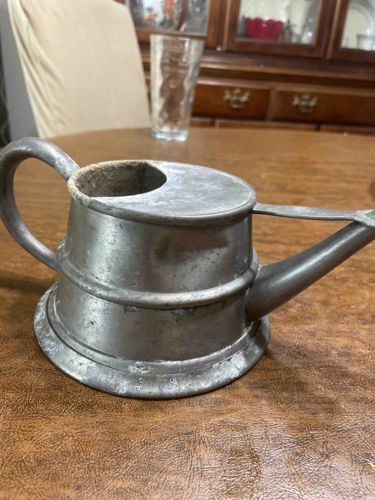
Pewter small indoor watering can Has dent on right side. Otherwise clean surfaces. Some calcium deposits
These notes were written by the person who submitted this item. Appraiser.AI has not verified them, and the AI's identification and estimate may rely on them.
AI Estimated Value
Not an official valuation
$40 - $75
AI estimate as of August 6, 2025 · verify with a professional before acting
AI-Generated · Verify before acting
Everything on this page is generated by AI for informational purposes only. AI can make mistakes — the AI may misidentify items or misattribute them (artist, maker, brand, designer, origin, era). This is not an official valuation and should not be used for insurance, sale, tax, estate, legal, or lending purposes — or any decision requiring a certified appraisal. It is not an authoritative claim about any person, brand, or rights holder — do not share or rely on it as a factual statement about a third party. Always consult qualified professionals before making financial decisions.
This analysis also relies on unverified notes provided by the user, which may be incomplete or inaccurate and could affect the result.
This item is a small, antique-style indoor watering can, constructed entirely from pewter. Its overall form is squat and utilitarian, featuring a cylindrical body with an integrated handle on one side and a long, slender pouring spout extending from the opposite side. The pewter material exhibits its characteristic matte, silvery-gray finish, which has developed a notable patina over time, indicating age. The main body of the can is encircled by a raised band or ridge, approximately midway up, adding a subtle decorative and structural element. The top surface is flat with a circular opening for filling, and the handle is a simple, curved loop. The base is wider than the body, creating a stable foot, and appears to be formed by flaring out the bottom rim.
Observable condition issues include a distinct dent on the right side of the main body, as seen from the perspective in the primary image. Despite this damage, the general surfaces appear relatively clean, though there are visible calcium deposits, particularly around the base and possibly near the spout opening, suggesting prolonged use with hard water. The interior of the filling hole shows some rougher, almost fibrous texture, which might be an accumulation of debris or a remnant from the casting/finishing process. There are no immediately discernible manufacturer's marks, signatures, or stamps visible in the provided image. Based on the material and unadorned, classic design, it likely dates to the late 19th or early to mid-20th century. The craftsmanship, while appearing solid and functional, points to a mass-produced item rather than a unique artisan piece, though the pewter itself suggests a certain level of enduring quality.
AI Appraisal Report
Upon my virtual examination of this pewter indoor watering can, I observe an antique-style piece with a squat, utilitarian form. The characteristic matte, silvery-gray finish of the pewter, along with a developed patina, strongly suggests age. The presence of a distinct dent on the right side of the main body is noted, as are calcium deposits, particularly around the base and possibly the spout, indicating prolonged use with hard water. The interior of the filling hole shows what appears to be either debris or a rough casting remnant. I find no discernible manufacturer's marks or signatures from the provided images, which is common for utilitarian items of this age.
Based on its material, unadorned design, and lack of refined finishing, I estimate its origin to be late 19th to early 20th century. While craftsmanship appears solid and functional, its character strongly suggests a mass-produced item rather than a unique artisan piece. The pewter material, however, does lend some inherent quality and durability.
In terms of market conditions, antique pewter utilitarian items like this are generally not considered rare. Demand is moderate, typically appealing to collectors of vintage household items or those seeking decorative gardenalia. Condition issues, such as the dent and calcium deposits, negatively impact aesthetic appeal and, consequently, value. Comparables for such items, when available, often show a modest valuation.
It is crucial to state the limitations of this appraisal: full authenticity verification is constrained by relying solely on images. A physical examination would allow me to accurately assess the extent of the dent, the nature of the interior 'fibrous texture,' and to thoroughly check for any obscured maker's marks or repairs. Furthermore, a tactile inspection would provide a more precise understanding of the pewter's quality, weight, and fabrication methods, which could influence dating and value. Without physical access and potentially provenance documentation or material testing, definitive authentication and a more precise dating remain speculative. Given these factors, the item's value is primarily decorative and utilitarian, not driven by rarity or significant artistic merit.