These notes were written by the person who submitted this item. Appraiser.AI has not verified them, and the AI's identification and estimate may rely on them.
AI Estimated Value
Not an official valuation
$350-550
AI estimate as of November 12, 2025 · verify with a professional before acting
AI-Generated · Verify before acting
Everything on this page is generated by AI for informational purposes only. AI can make mistakes — the AI may misidentify items or misattribute them (artist, maker, brand, designer, origin, era). This is not an official valuation and should not be used for insurance, sale, tax, estate, legal, or lending purposes — or any decision requiring a certified appraisal. It is not an authoritative claim about any person, brand, or rights holder — do not share or rely on it as a factual statement about a third party. Always consult qualified professionals before making financial decisions.
This analysis also relies on unverified notes provided by the user, which may be incomplete or inaccurate and could affect the result.
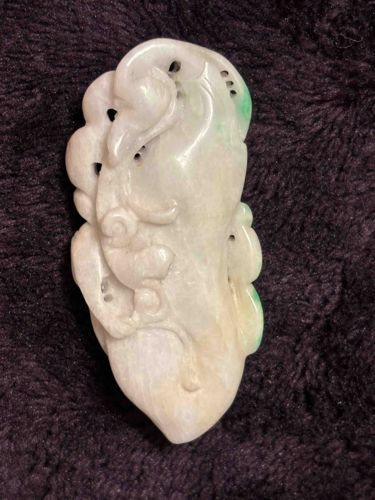
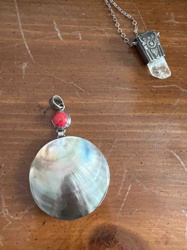
This is a vintage carved jade pendant, exhibiting an intricate and flowing design. The primary color of the jade is a creamy white or very pale celadon, indicative of high-quality nephrite or a lighter shade of jadeite. There are notable veins and patches of vibrant green, visible particularly along the top and right edges, which add depth and contrast to the piece. The carving features stylized forms that could represent mythological creatures, foliage, or auspicious symbols, common in traditional East Asian artistry. Details such as fluid curves, small circular cutouts, and raised sections suggest a skilled hand. The surface appears well-polished, contributing to a soft sheen, though some areas might show minor wear consistent with its vintage nature. There are no obvious chips, cracks, or repairs visible in the provided image. The overall style suggests an East Asian origin, likely Chinese, and its vintage designation implies it could range from several decades to potentially a century or more old. The craftsmanship appears to be of good quality, focusing on aesthetic flow and symbolic representation rather than strict realism. The natural color variations and translucency common in jade are present, enhancing its organic beauty. The absence of specific maker's marks or signatures is common for such items, and its quality is judged by the stone's characteristics and the intricacy of the carving.
AI Appraisal Report
I have carefully examined the provided image of the carved jade pendant. From the visual evidence, the pendant appears to be a vintage piece with intricate carving, likely depicting stylized forms common in East Asian art. The primary color of the jade is a creamy white or pale celadon, with notable veins of vibrant green, which contribute to its aesthetic appeal and suggest natural variations in the stone. The craftsmanship appears to be skilled, with fluid curves and polished surfaces indicative of quality work. The condition, based solely on the image, seems good, showing no obvious chips, cracks, or repairs, though minor wear consistent with its vintage nature would be expected.
Regarding authenticity, visually, the stone's characteristics and carving style are consistent with genuine jade and traditional East Asian craftsmanship. However, verifying the exact type of jade (nephrite vs. jadeite) and its origin, as well as definitively ruling out modern simulants or treatments, is impossible from photographs alone. Market conditions for vintage jade pendants like this are moderately steady, with a decent demand from collectors and enthusiasts. Comparables in this price range typically feature similar levels of carving intricacy and apparent stone quality. The rarity of this specific design is difficult to ascertain without extensive market research, but similar carved jade pieces are regularly available.
Factors impacting value include the seeming quality of the carving, the attractive color variation of the stone, and its vintage appeal. For a full authenticity verification, a direct, in-person examination would be crucial to assess the true translucency, texture, and density of the stone. Scientific testing, such as refractometer readings or specific gravity tests, would confirm its mineral composition. Documentation of provenance would significantly enhance its historical and market value. Without these, my valuation remains a visual assessment and is subject to revision upon physical inspection.