These notes were written by the person who submitted this item. Appraiser.AI has not verified them, and the AI's identification and estimate may rely on them.
AI Estimated Value
Not an official valuation
$600-900
AI estimate as of September 6, 2025 · verify with a professional before acting
AI-Generated · Verify before acting
Everything on this page is generated by AI for informational purposes only. AI can make mistakes — the AI may misidentify items or misattribute them (artist, maker, brand, designer, origin, era). This is not an official valuation and should not be used for insurance, sale, tax, estate, legal, or lending purposes — or any decision requiring a certified appraisal. It is not an authoritative claim about any person, brand, or rights holder — do not share or rely on it as a factual statement about a third party. Always consult qualified professionals before making financial decisions.
This analysis also relies on unverified notes provided by the user, which may be incomplete or inaccurate and could affect the result.
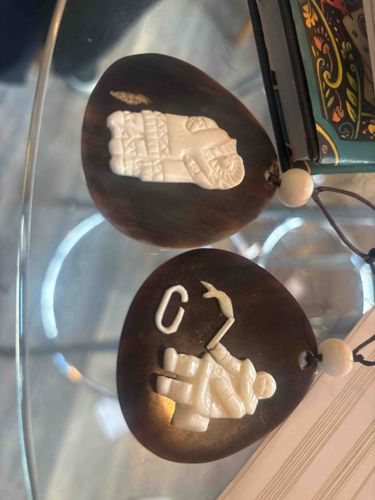
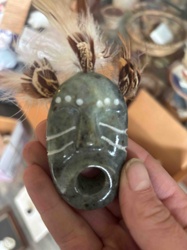
This lot features two intricately carved pendants, each combining a dark, natural shell base with white, possibly ivory, carved inlays. Each pendant is roughly ovular in shape, with the dark shell providing a contrasting backdrop for the light-colored carvings. The top pendant features a relief carving of what appears to be an armored or ceremonial figure, possibly a warrior or deity, depicted in profile, facing right. The details of its 'armor' or clothing are rendered with geometric patterns and lines, suggesting a structured garment or body covering. The craftsmanship indicates fine detail work, particularly in the rendering of the figure's head, which seems to include a helmet or headdress with a curved horn or tusk-like element. The lower pendant displays a fragmented carving that includes a stylized 'C' or hook-like symbol at the top left, alongside another figure or object. This figure also exhibits segmented or patterned clothing/armor, similar to the upper pendant, suggesting a related style or theme. There is a noticeable break or loss of material in the white carving on the lower pendant, particularly around the center, which appears to be a condition issue rather than intentional design. Both pendants feature a drilled hole at the narrower end, indicating they are designed to be worn as necklaces or attached to other items, with the top pendant showing a small, rounded white bead attached via a string or cord, and the cord itself visible. The shell bases show a natural, smooth finish with subtle variations in color, characteristic of organic materials. The perceived 'ivory' elements exhibit a consistent off-white to cream color, with a smooth, polished surface. Given the style and material combination, these resemble items of tribal art or folk art, potentially from Southeast Asia, Oceania, or a similar region known for shell and bone/ivory carving traditions. The estimated age is difficult to pinpoint without further context but they appear to be vintage or antique, exhibiting a natural patina on the shell and possible discoloration or wear on the carved elements consistent with age and handling. The quality of craftsmanship is high, particularly in the detailed relief work of the figures.
AI Appraisal Report
Upon examining the provided image of these two carved shell and ivory pendants, I note their intriguing design and craftsmanship. The dark shell base, serving as a contrasting backdrop for the finely carved, light-colored figures, is striking. The top pendant, with its detailed relief carving of an armored figure, exhibits excellent artistry. The geometric patterns and the unique headdress suggest a specific cultural origin, likely Southeast Asian or Oceanic, known for such intricate work. The lower pendant, despite a noticeable material loss in its central carving, shows similar stylistic elements, indicating they are a pair or from the same artisan/region. The drilled holes confirm their use as adornments. The 'ivory' elements appear to be of good quality, showing a consistent off-white to cream color and a smooth finish. Authenticity of the ivory cannot be definitively confirmed from images alone; without in-person examination, including grain patterns and UV light testing, or scientific analysis (e.g., microscopic examination, spectroscopic analysis), it is impossible to distinguish natural ivory from bone or synthetic substitutes. Provenance documentation, such as the 'Ivory Zola' mentioned by the owner, would be crucial for full authentication and ethical trade considerations, especially given current restrictions on ivory.
Condition-wise, the upper pendant appears good, while the lower one has a significant loss impacting its aesthetic and structural integrity. This condition issue, combined with the unverified ivory content, impacts value.
Market demand for ethnographic or tribal jewelry is moderate but active for well-preserved and authenticated pieces. Comparables for similar shell and carved bone/ivory pendants from the specified regions, assuming they are indeed antique/vintage and the white material is confirmed as genuine ivory, range from $300-$500 each for good condition. The pair's uniqueness and artistic merit elevate their appeal. Given the condition issue on the lower pendant and the critical need for material authentication, I estimate a value range of $600-$900 for the pair, assuming the white carvings are confirmed as genuine ivory or a desirable bone substitute. Should the material prove to be a less desirable substitute or not antique, the value would be lower.