AI Appraisal Estimate

AI-generated estimates · not official valuations

From the user

What was submitted

Photo and notes provided by the user — not generated by AI

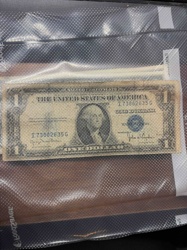
Submitted item photo
Submitted photo · June 20, 2026

User's notes

No additional notes provided.

AI analysis below

AI appraisal

AI analysis & estimate

AI-Generated · Verify before acting

Everything below is generated by AI for informational purposes only. AI can make mistakes — the AI may misidentify items or misattribute them (artist, maker, brand, designer, origin, era). This is not an official valuation and should not be used for insurance, sale, tax, estate, legal, or lending purposes — or any decision requiring a certified appraisal. It is not an authoritative claim about any person, brand, or rights holder — do not share or rely on it as a factual statement about a third party. Always consult qualified professionals before making financial decisions.

Read the full disclaimer

AI Identification

·Not independently authenticated·Verify before acting

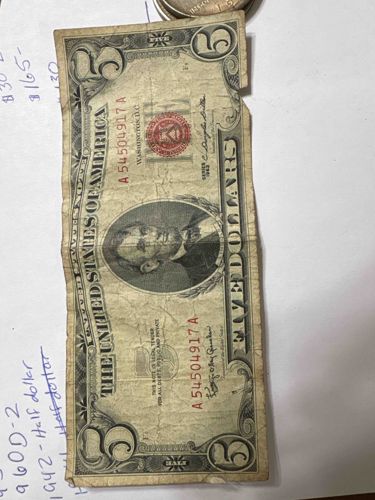
Series 1963 $5 United States Legal Tender Note (Red Seal)

Numismatics / US Paper Currency

AI Estimated Value

·Not an official valuation·Verify before acting

$6.00-$8.50

As of June 20, 2026

AI Item Analysis

·AI can make mistakes·Verify before acting
This is a Series 1963 $5 United States Legal Tender Note, commonly referred to by collectors as a 'Red Seal' note due to the distinctive red ink used for the Treasury Seal and serial numbers. The note features the central portrait of Abraham Lincoln. The serial number is A 54504917 A, and it bears the signatures of Kathryn O'Hay Granahan (Treasurer) and C. Douglas Dillon (Secretary of the Treasury). The bill is printed on standard banknote paper (linen/cotton blend) and measures approximately 6.14 by 2.61 inches. The reverse design, while not fully visible, would typically depict the Lincoln Memorial. In terms of condition, this specimen shows significant signs of circulative wear. There are prominent vertical and horizontal folds, heavy creasing, and overall surface soiling that has darkened the paper. Notably, there is a large mechanical tear or notch missing from the upper edge (right side when oriented vertically) and further minor chipping and fraying along the peripheries. The red ink remains legible but has faded slightly. This variety of currency was the last small-size $5 legal tender note issued before the system shifted toward Federal Reserve Notes for this denomination. Due to the significant paper damage and heavy circulation, its value is primarily as a historical curiosity rather than a high-grade numismatic specimen.
AI Appraisal Report

·AI can make mistakes·Verify before acting
I have conducted a visual examination of this Series 1963 $5 United States Legal Tender Note. The note features the characteristic Red Seal and serial numbers (A 54504917 A) indicative of the Granahan-Dillon signature combination. Authenticity appears consistent with circulating currency of the era based on font style, color of the red overprint, and paper texture visible in the image. However, the condition of this specimen is graded as 'Good' to 'Very Good' (G-VG) at best, primarily due to severe structural compromises. The heavy vertical and horizontal creasing, significant surface soiling, and most critically, the large mechanical tear/missing piece on the upper edge, severely limit its numismatic appeal. In the current market, Series 1963 Red Seals are relatively common, as they were the final small-size $5 legal tender notes produced. While high-grade 'Uncirculated' examples command premiums, heavily circulated and damaged notes trade just slightly above face value. Collectors generally seek specimens without structural loss (tears or holes). The current valuation is driven by its status as a historical curiosity rather than investment-grade paper. Limitations: This appraisal is based strictly on a digital surrogate. A definitive guarantee of authenticity requires physical inspection to verify the presence of red and blue security fibers in the paper and to perform a UV light test for contemporary counterfeiting methods. No provenance was provided; however, given the low value of the note, the cost of professional grading (e.g., PMG) would exceed the value of the note itself.

Get your items appraised

Instant estimates of your treasures with AI-powered appraisals

Browse More Appraisals