AI estimate as of October 22, 2025 · verify with a professional before acting
AI-Generated · Verify before acting
Everything on this page is generated by AI for informational purposes only. AI can make mistakes — the AI may misidentify items or misattribute them (artist, maker, brand, designer, origin, era). This is not an official valuation and should not be used for insurance, sale, tax, estate, legal, or lending purposes — or any decision requiring a certified appraisal. It is not an authoritative claim about any person, brand, or rights holder — do not share or rely on it as a factual statement about a third party. Always consult qualified professionals before making financial decisions.
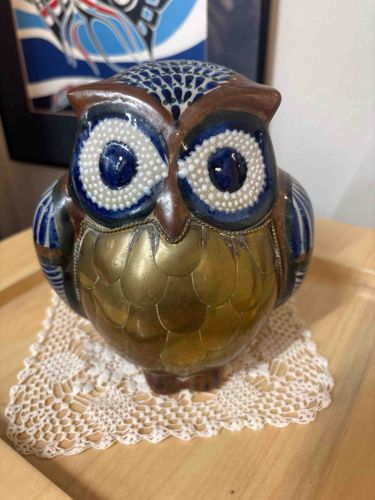
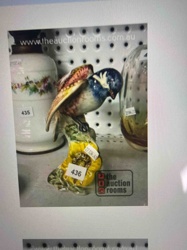
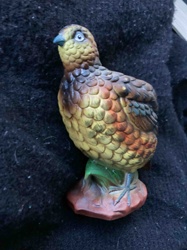
This item is a decorative owl figurine or sculpture, crafted from a combination of ceramic or pottery and brass. The owl stands upright, featuring distinct sections of different materials and finishes. The upper part of the owl, including its head and shoulders, appears to be made of ceramic or a similar glazed material. The head is predominantly brown with two large, expressive eyes that are a focal point. These eyes consist of a dark blue, possibly glazed, central pupil surrounded by a ring of small, raised white ceramic 'pearls' or dots, which in turn are encircled by a dark blue rim. The top of the head features a textured pattern of white dots against a dark blue background, reminiscent of feathers. Small brown owl 'ears' or tufts protrude from the top of the head. The sides of the owl's body, partially visible, show vertical dark blue and white striped or feathered patterns on what appears to be more ceramic material. The lower two-thirds of the owl's body is covered in brass, fashioned into overlapping scales, resembling feathers. This brass section has a warm, somewhat tarnished golden hue, indicating natural aging and patina, or an intentional antique finish. A thin, braided metallic wire or trim separates the ceramic upper body from the brass lower body, adding a refined detail. The overall condition appears good, with the brass showing expected patina for its age and material. No visible chips, cracks, or significant damage are apparent from the provided images, though a full inspection would be required to confirm. The craftsmanship suggests a unique, possibly handcrafted piece, combining different artistic techniques and materials to create a whimsical yet elegant animal representation. The style hints at a mid-20th century to contemporary decorative art piece, possibly from an artisan studio.
AI Appraisal Report
I have examined the provided image of this Mixed Media Owl Figurine/Sculpture. Visually, the condition appears good, with the brass exhibiting an expected patina consistent with age or an intentional antique finish. I observe no obvious chips, cracks, or significant damage to the ceramic components from the image. The craftsmanship, combining ceramic and brass with intricate details like the pearl-ringed eyes and scaled brass body, suggests a unique, possibly handcrafted or studio art piece.
Authenticity is difficult to ascertain definitively from images alone. While it presents as a mid-20th century to contemporary decorative art piece, without physical inspection, I cannot confirm materials with certainty, nor can I identify a specific artist or studio. Market conditions for mixed media decorative owls vary significantly based on artist, provenance, and material quality. Comparable pieces from known artists or studios can fetch higher prices, while unsigned, mass-produced items would be considerably less.
Factors impacting value include its unique aesthetic, presumed good condition, and the combination of materials which adds to its decorative appeal. Demand for such whimsical yet elegant animal sculptures is generally moderate, appealing to collectors of decorative arts or owl-themed items. Rarity is harder to gauge; it doesn't appear to be a common production piece, suggesting it's not widely available.
To fully authenticate and confirm the value, an in-person examination is crucial. This would allow for a precise determination of material composition (e.g., type of ceramic, brass quality), assessment of any hidden repairs or flaws, and a closer inspection for artist signatures or maker's marks. Provenance documentation, if available, would significantly enhance its value by linking it to a specific artist or a notable collection. Without such information, the current appraisal reflects its decorative value as a unique, well-crafted item.