AI estimate as of November 14, 2025 · verify with a professional before acting
AI-Generated · Verify before acting
Everything on this page is generated by AI for informational purposes only. AI can make mistakes — the AI may misidentify items or misattribute them (artist, maker, brand, designer, origin, era). This is not an official valuation and should not be used for insurance, sale, tax, estate, legal, or lending purposes — or any decision requiring a certified appraisal. It is not an authoritative claim about any person, brand, or rights holder — do not share or rely on it as a factual statement about a third party. Always consult qualified professionals before making financial decisions.
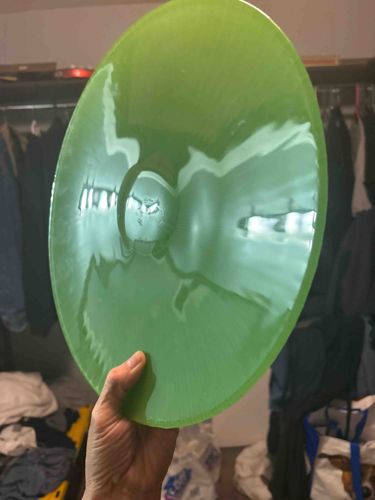
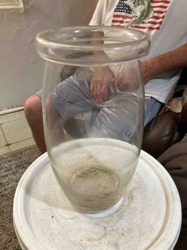
This item is a circular, shallow basin or dish made from translucent green plastic. Its primary color is a vibrant, light green, which appears to be uniform throughout the material. The surface is smooth and highly reflective, showing clear reflections of the surrounding environment, although the specific details of the room are indistinct. The dish has a slightly raised central area, creating a subtle concave shape across its inner surface, which suggests it is designed to hold liquids or small items. The edges are smoothly finished, indicating a molded plastic construction. There are no visible cracks, chips, or significant scuffs on the surface, implying it is in good, possibly unused or well-maintained condition. The material appears to be a durable plastic, typical for household items or laboratory equipment. Its simple, functional design doesn't suggest a specific artistic style or period, but rather a utility item likely produced in the latter half of the 20th century or more recently. There are no discernible manufacturer's marks, signatures, or specific brand identifiers visible in the provided image. The quality of craftsmanship appears to be standard for a mass-produced plastic item.
AI Appraisal Report
I have carefully examined the provided image of the translucent green plastic dish or basin. The item appears to be in excellent condition, with a smooth, reflective surface and no visible cracks, chips, or significant scuffs. Its uniform light green color and simple, functional design suggest a mass-produced utility item. Authenticity, in the sense of verifying its material composition (plastic) and manufacturing method (molded), is consistent with visual cues.
Based on current market conditions for similar household plastic items, bowls, or basins, the demand is generally low unless the item possesses unique design, branding, or historical significance. This piece lacks any discernible manufacturer's marks or stylistic elements that would suggest rarity or collectible value. Its utility is its primary characteristic, and such items are widely available new at very low price points. Therefore, its intrinsic value is minimal, primarily driven by its functional use rather than any artistic or antique merit.
Factors significantly impacting its value include its common material, lack of branding, and readily available modern equivalents. Without any unique features, its market appeal is limited to those seeking a basic, functional plastic dish.
It is important to note the limitations of appraising solely from an image. While the condition appears excellent, a physical examination would be necessary to confirm the absence of subtle surface imperfections, assess the exact type of plastic, and verify its structural integrity. Furthermore, detailed provenance documentation would be required to establish any potential historical significance, though none is suggested by the item's appearance. Scientific testing of the material could confirm its exact plastic composition and age if it contains any specific polymers that might alter its value, but for this type of item, such testing is generally not cost-effective or necessary given its likely low value.