AI estimate as of July 3, 2025 · verify with a professional before acting
AI-Generated · Verify before acting
Everything on this page is generated by AI for informational purposes only. AI can make mistakes — the AI may misidentify items or misattribute them (artist, maker, brand, designer, origin, era). This is not an official valuation and should not be used for insurance, sale, tax, estate, legal, or lending purposes — or any decision requiring a certified appraisal. It is not an authoritative claim about any person, brand, or rights holder — do not share or rely on it as a factual statement about a third party. Always consult qualified professionals before making financial decisions.
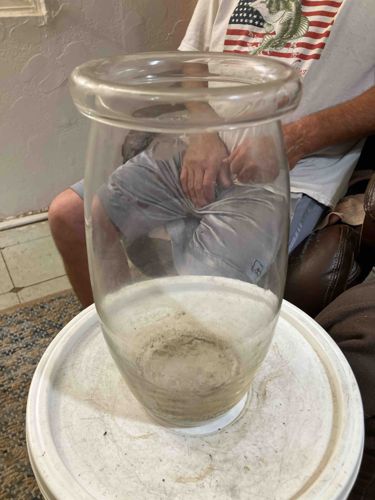
This item is a clear glass jar or vase, characterized by its thick walls and somewhat bulbous, albeit slightly tapered, overall shape. The top rim is distinctly rolled and thickened, forming a smooth, rounded edge that suggests robust construction. The glass appears to be hand-blown or at least hand-finished, evidenced by the subtle irregularities in the glass thickness and the organic curve of the neck. There are no visible seams, which further supports the possibility of mouth-blown production. The bottom tapers to a narrower base, which is not fully visible but appears to be flat. The interior base of the vessel shows a significant accumulation of light brown or beige particulate matter, likely dust, dirt, or sediment, indicating prolonged disuse or use for storing dry contents. No cracks, chips, or major damage are apparent from the visible angles, though the overall surface appears somewhat dusty, consistent with the interior. There are no discernible maker's marks, signatures, or stamps. Given its simple, functional design and robust construction, it could be a utilitarian piece such as a pickle jar, a large food storage container, a terrarium bottom, or even a very large vase. The clear glass suggests it was intended for contents, either decorative or practical, to be visible. The lack of elaborate decoration indicates a focus on functionality and form rather than ornate aesthetics. It appears to be an older piece, potentially mid-20th century or earlier, based on the apparent glass quality and construction style.
AI Appraisal Report
I have examined the provided image of this large clear glass jar/vase with a rolled rim. Visually, the piece appears to be in good overall condition with no visible chips, cracks, or significant damage. The presence of dust and particulate matter inside suggests long-term storage or use, consistent with an older item. The rolled rim and lack of visible seams strongly suggest it is a mouth-blown piece, likely dating from the mid-20th century or earlier.
This type of utilitarian glassware typically falls into a lower value bracket unless it possesses unique historical significance, a rare maker's mark, or exceptional artistry, none of which are evident from the image. Its simple, functional design makes it suitable for various uses, which can slightly broaden its appeal. The market for such common, albeit attractive, vintage household glass is generally stable but not highly lucrative. Comparable items, such as large vintage pickle jars or utilitarian storage vessels of similar age and quality, usually retail in the $20-$60 range depending on size, condition, and sales venue (flea market vs. antique shop).
Demand is moderate for decorative or functional pieces of this nature, but rarity is low. Factors impacting value negatively include the absence of a discernible maker's mark, which would help identify its origin and potentially increase its collectible appeal. The lack of elaborate decoration also limits its aesthetic 'wow' factor.
My primary limitation in this appraisal is the lack of physical examination. An in-person inspection would allow me to fully assess the glass quality, confirm the absence of seams definitively, check for subtle damage or wear not visible in the image, and search for faint maker's marks or pontil scars that could indicate specific production methods or origins. Provenance documentation could also significantly impact value by linking it to a notable history or use. Without these, the appraisal remains based solely on visual characteristics from the provided image.