AI estimate as of September 9, 2025 · verify with a professional before acting
AI-Generated · Verify before acting
Everything on this page is generated by AI for informational purposes only. AI can make mistakes — the AI may misidentify items or misattribute them (artist, maker, brand, designer, origin, era). This is not an official valuation and should not be used for insurance, sale, tax, estate, legal, or lending purposes — or any decision requiring a certified appraisal. It is not an authoritative claim about any person, brand, or rights holder — do not share or rely on it as a factual statement about a third party. Always consult qualified professionals before making financial decisions.
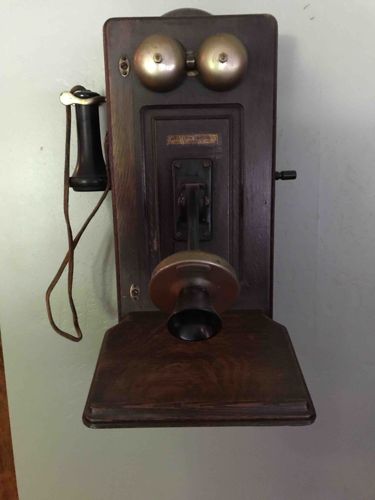
This is an antique wall-mounted crank telephone, likely dating from the late 19th to early 20th century, specifically the 1890s to 1910s. The primary material is dark stained wood, possibly oak or walnut, which forms the main rectangular back board and the lower shelf. The wood exhibits a rich, deep brown color with visible grain, suggesting a natural finish that has darkened over time, or a dark stain applied during manufacturing. There is some visible wear and minor surface abrasions consistent with age and use on the wooden surfaces, particularly on the edges of the shelf and the main board, contributing to its authentic patina. The construction appears sturdy, with visible joinery or screws securing various components to the wooden backboard.
Key features include two prominent brass bells mounted at the top, which show some tarnish and minor discoloration typical of aged brass but no significant dents or damage. Below the bells, a small rectangular nameplate or instruction plate is visible, though the text is illegible from the image. To the left, a black, possibly bakelite or hard rubber, hand receiver is suspended by a metal and wood hook. The fabric-covered cord connecting the receiver to the main unit appears aged and somewhat frayed in places. Below the nameplate, a central crank mechanism is visible, likely used to generate a signal for the operator, with a visible metal crankshaft and a small, dark crank handle protruding from the right side of the wooden board. At the bottom, a heavy brass or bronze voice transmitter/mouthpiece extends from the wooden shelf, featuring a a cylindrical shape with a flared, dark opening. The craftsmanship appears robust and functional, characteristic of early telecommunication devices. There are no obvious signs of recent repairs, suggesting the components are original. The overall condition appears to be good for its age, showcasing historical significance.
AI Appraisal Report
Upon my virtual examination of this antique wall-mounted crank telephone, I assess its condition to be good for its age. The dark-stained wood, likely oak or walnut, shows an authentic patina with wear and minor abrasions consistent with late 19th to early 20th-century use. The brass bells exhibit expected tarnish, but I see no significant damage. The hand receiver, possibly bakelite or hard rubber, appears intact, although the fabric-covered cord shows typical aging and fraying. The central crank mechanism and the heavy brass/bronze mouthpiece/transmitter also appear original and in functional visual condition. Authenticity seems high, as all components visually align with period examples and show no obvious signs of modern replacement or repair.
Market conditions for antique telecommunications equipment, especially well-preserved crank telephones, remain stable with a steady demand from collectors of Americana, historical technology, and decorative enthusiasts. These items are not exceedingly rare, but finding examples in this good, original condition without significant restoration is becoming less common. Comparables typically range from $400 for more common or less preserved models to over $1,200 for exceptionally rare or mint-condition examples. This particular piece falls comfortably in the middle, given its completeness and visual state. Factors positively impacting its value include its apparent originality, complete components, and charming aesthetic.
It is important to note that my assessment of authenticity is based solely on visual inspection of the image provided. A definitive authentication would require an in-person examination to verify the material composition of components (e.g., confirming bakelite vs. early plastic, brass vs. plated metal), assess the internal mechanisms for originality and functionality, and inspect for any hidden repairs or restorations. Provenance documentation, such as original purchase receipts or period photographs, would further enhance its value and historical accuracy.