AI estimate as of September 20, 2025 · verify with a professional before acting
AI-Generated · Verify before acting
Everything on this page is generated by AI for informational purposes only. AI can make mistakes — the AI may misidentify items or misattribute them (artist, maker, brand, designer, origin, era). This is not an official valuation and should not be used for insurance, sale, tax, estate, legal, or lending purposes — or any decision requiring a certified appraisal. It is not an authoritative claim about any person, brand, or rights holder — do not share or rely on it as a factual statement about a third party. Always consult qualified professionals before making financial decisions.
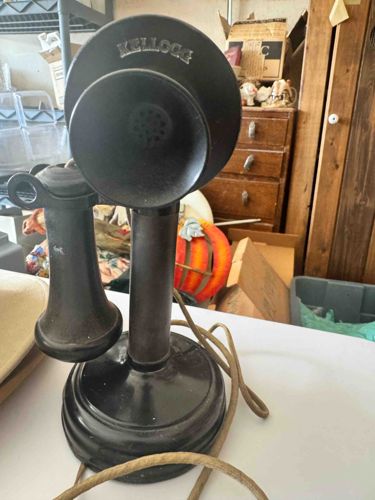
This item is an antique Kellogg pedestal telephone, commonly known as a 'candlestick phone,' dating likely from the early 20th century, possibly 1900s to 1920s. It features a classic all-black construction, typical of early telephones. The primary visible materials appear to be metal, likely cast iron or brass with a black enamel or japanned finish, and possibly ebonite or Bakelite for the receiver and mouthpiece components. The base is circular with a ribbed or stepped design, providing stability, from which a slender, vertical shaft rises. Attached to the top of this shaft is the mouthpiece, a flared, funnel-shaped component, directly below which the word "KELLOGG" is prominently molded in raised, sans-serif lettering on the surrounding disc. To the left of the main shaft, a separate hook is affixed, from which a single receiver hangs. The receiver appears to be a solid, bell-shaped piece with a smooth, dark surface, connected by a short, integrated arm to the main telephone body. A fabric-covered electrical cord, a common feature of this era, extends from the base, showing some signs of fraying or wear consistent with its age. The overall condition appears to be fair to good for an item of its age, exhibiting a natural patina and some minor surface wear, but no obvious significant damage like cracks or large chips are discernible from the provided images. The finish may have some scuffs or dulling over time. This particular model represents a significant period in telecommunication history, showcasing early design principles focused on functional form.
AI Appraisal Report
Based on my visual examination of the provided image, this Kellogg pedestal telephone appears to be an authentic example of an early 20th-century 'candlestick phone,' likely dating from the 1900s to 1920s. The 'KELLOGG' molding on the mouthpiece disk is consistent with known examples of their production. The materials—metal (likely cast iron/brass with black finish) and ebonite/Bakelite components—also align with early telephone manufacturing. The overall condition, while showing age-appropriate wear such as finish dulling and fraying on the fabric cord, seems fair to good. I do not observe any significant damage like cracks or chips that would drastically diminish its value, though minor scuffs are present.
Market conditions for antique telephones like this vary. While there's a steady interest from collectors of telecommunications memorabilia and antique enthusiasts, demand is moderate rather than exceptionally high for common models. This particular Kellogg model, while iconic, is not exceedingly rare. Comparables for similar Kellogg candlestick phones in fair to good unrestored condition typically range from $200 to $500, with exceptionally preserved or rare variations reaching higher. Factors impacting this value include its unrestored state, which some collectors prefer, but also the visible cord wear and potential internal component issues.
Limitations in authenticity verification from a single image are significant. While the visible characteristics are consistent, I cannot definitively confirm authenticity without a physical inspection. An in-person examination would allow me to assess the internal components, verify materials, check for repairs or replaced parts, and thoroughly evaluate the entire surface for damage not visible in the image. Provenance documentation, though rare for such items, would further strengthen authenticity. Scientific testing, such as material analysis, would be primarily reserved for cases where provenance is highly questionable or for high-value rare items, which this TBD is not.