AI Appraisal Estimate

AI-generated estimates · not official valuations

From the user

What was submitted

Photo and notes provided by the user — not generated by AI

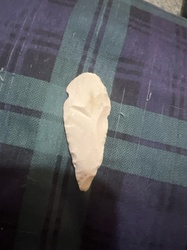
Submitted item photo
Submitted photo · June 20, 2026

User's notes

No additional notes provided.

AI analysis below

AI appraisal

AI analysis & estimate

AI-Generated · Verify before acting

Everything below is generated by AI for informational purposes only. AI can make mistakes — the AI may misidentify items or misattribute them (artist, maker, brand, designer, origin, era). This is not an official valuation and should not be used for insurance, sale, tax, estate, legal, or lending purposes — or any decision requiring a certified appraisal. It is not an authoritative claim about any person, brand, or rights holder — do not share or rely on it as a factual statement about a third party. Always consult qualified professionals before making financial decisions.

Read the full disclaimer

AI Identification

·Not independently authenticated·Verify before acting

Antiquity-Style Stone Grinding Slab or Metate

Archaeological Artifacts / Primitive Kitchenware

AI Estimated Value

·Not an official valuation·Verify before acting

$400 - $700

As of June 20, 2026

AI Item Analysis

·AI can make mistakes·Verify before acting
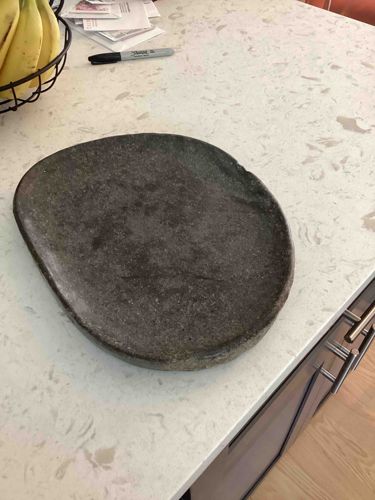
This item is a hand-carved, shallow basin or slab fashioned from a dark, dense igneous rock, likely basalt or a similar volcanic stone. Physically, the object features an irregular, organic oval shape with a noticeably recessed central area, indicating it was used for grinding or as a primitive vessel. The material exhibits a coarse, porous texture with a dark charcoal to grayish-brown coloration. Its construction is heavy and monolithic, showing signs of manual shaping through pecking or grinding techniques rather than modern industrial cutting. Notable markings include several deep scratches or gouges in the center of the depression and uneven rim edges that suggest heavy historical use. The condition reveals significant age-related wear, with a dull patina across the surface, some chipping along the outer periphery, and localized light-colored mineral deposits or residue in the pores. No visible maker’s marks or signatures are present, which is typical for such utilitarian artifacts. The style is characteristic of ancient or indigenous kitchen tools, such as a mesoamerican metate or an archaic grinding stone, making it difficult to date precisely without provenance, though its weathered appearance points to substantial age. The quality is rustic yet durable, emphasizing functional craftsmanship designed for long-term survival under repetitive abrasive tasks.
AI Appraisal Report

·AI can make mistakes·Verify before acting
I have carefully examined the provided images of this stone grinding slab, commonly referred to as a metate. This piece is fashioned from a dense volcanic basalt, exhibiting the characteristic vesicular texture and dark gray patina associated with long-term exposure and usage. The manual pecking marks and irregular oval trough suggest traditional manufacturing techniques. The surface shows localized mineral accretions and differential wear in the central basin, which are positive indicators of age and functional history. The market for utilitarian archaeological artifacts is currently stable, with collectors prioritizing provenance and regional specificity. Comparable basalt metates without elaborate zoomorphic carvings or pedestals typically sell within the mid-hundreds at auction. Pre-Columbian or archaic North American origins are likely, though the absence of decorative motifs limits the ceiling for its valuation. Several factors impact this appraisal. The lack of a matching 'mano' (hand stone) slightly reduces the value. Crucially, without documented provenance or a collection history, it is difficult to distinguish a genuine antiquity from a more modern ethno-historic tool used by indigenous populations in the 19th or early 20th century. Limitations: My assessment is based solely on high-resolution images. To confirm authenticity and refine this valuation, a physical examination is required to verify the 'desert varnish' and chemical composition of the mineral deposits. Authentic artifacts should show microscopic striations consistent with organic grain processing. I strongly recommend securing carbon dating of any organic residue or obtaining original find-site documentation to confirm legal compliance with cultural property laws and to establish a firm historical timeline.

Get your items appraised

Instant estimates of your treasures with AI-powered appraisals

Browse More Appraisals