AI Appraisal Estimate

AI-generated estimates · not official valuations

From the user

What was submitted

Photo and notes provided by the user — not generated by AI

Submitted item photo
Submitted photo · June 16, 2026

User's notes

No additional notes provided.

AI analysis below

AI appraisal

AI analysis & estimate

AI-Generated · Verify before acting

Everything below is generated by AI for informational purposes only. AI can make mistakes — the AI may misidentify items or misattribute them (artist, maker, brand, designer, origin, era). This is not an official valuation and should not be used for insurance, sale, tax, estate, legal, or lending purposes — or any decision requiring a certified appraisal. It is not an authoritative claim about any person, brand, or rights holder — do not share or rely on it as a factual statement about a third party. Always consult qualified professionals before making financial decisions.

Read the full disclaimer

AI Identification

·Not independently authenticated·Verify before acting

Area rug in the Bukhara style

Rugs and Floor Coverings

AI Estimated Value

·Not an official valuation·Verify before acting

$600 - $1,200

As of June 16, 2026

AI Item Analysis

·AI can make mistakes·Verify before acting
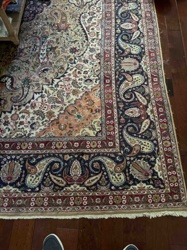
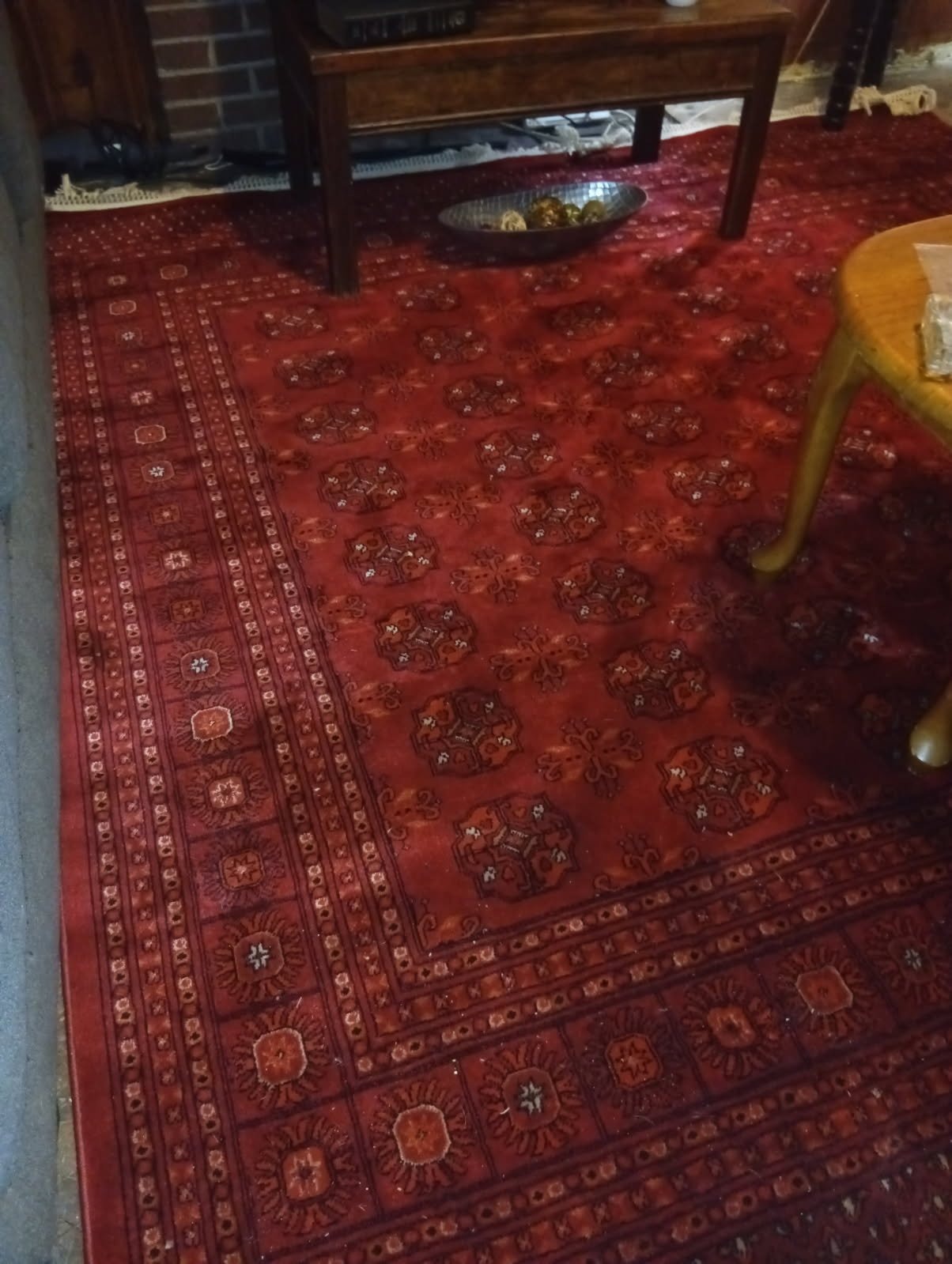
This rectangular area rug features a predominant deep crimson or madder red field, decorated with a repeating pattern of geometric motifs. The central field contains rows of gul-like octagonal medallions, which are stylistically consistent with Turkoman or 'Bukhara' designs often found in rugs from Central Asia or Pakistan. The pattern is executed in shades of black, dark blue, and cream or ivory. The rug is framed by multiple borders, including a primary border featuring sunburst or floral-shaped geometric medallions contained within square compartments, further bounded by thin guard strips with simple repeating linear and hooked motifs. The piece appears to be made of wool with a low-to-medium pile, though the specific fiber content and construction (hand-knotted vs. machine-made) cannot be verified without a physical inspection of the rug's reverse side and fringe. The visible edges show basic overcast stitching or binding. Condition appears generally good with no major staining or holes visible, though there is slight unevenness in the color that may be consistent with natural light exposure or minor wear. Because no manufacturer's label or weaver's signature is visible in the image, the identification is based solely on the traditional geometric iconography and color palette characteristic of the region's tribal weaving traditions.
AI Appraisal Report

·AI can make mistakes·Verify before acting
Based on my visual analysis of the provided image, this rug exhibits the characteristic 'Bukhara' or Turkoman-style gul motifs on a deep crimson field. The repeat geometric patterns and multi-bordered layout are consistent with tribal weaving traditions from Central Asia or Pakistan. Based on what I can see, the pile appears to be wool, and the condition seems generally well-maintained, though I cannot verify fiber content, knot density, or the specific method of construction (such as hand-knotted versus machine-made) without a physical inspection of the rug's foundation and reverse side. The value estimate is reflective of a high-quality hand-knotted wool rug of these dimensions. If the piece is indeed a hand-knotted wool rug with high knot density, it would likely fall into the upper end of the $600 to $1,200 range. However, if a physical examination reveals it to be machine-made or composed of synthetic fibers, the value would decrease significantly, potentially to $150 or less. General market demand for traditional Bukhara-style rugs remains stable for home decor, though values are highly sensitive to the method of manufacture and materials used. To provide a more accurate valuation, a physical examination would be required to assess the fringe construction, the presence of any moth damage not visible in the photograph, and the consistency of the dyes used. Evidence of provenance or a weaver's certificate would also assist in narrowing the estimate. This appraisal assumes the piece is a traditional hand-woven floor covering and should not be taken as a claim of authenticity or specific regional origin without further testing.

Related Tags

Explore similar items and categories

Get your items appraised

Instant estimates of your treasures with AI-powered appraisals

Browse More Appraisals