These notes were written by the person who submitted this item. Appraiser.AI has not verified them, and the AI's identification and estimate may rely on them.
AI Estimated Value
Not an official valuation
$150-250
AI estimate as of August 27, 2025 · verify with a professional before acting
AI-Generated · Verify before acting
Everything on this page is generated by AI for informational purposes only. AI can make mistakes — the AI may misidentify items or misattribute them (artist, maker, brand, designer, origin, era). This is not an official valuation and should not be used for insurance, sale, tax, estate, legal, or lending purposes — or any decision requiring a certified appraisal. It is not an authoritative claim about any person, brand, or rights holder — do not share or rely on it as a factual statement about a third party. Always consult qualified professionals before making financial decisions.
This analysis also relies on unverified notes provided by the user, which may be incomplete or inaccurate and could affect the result.
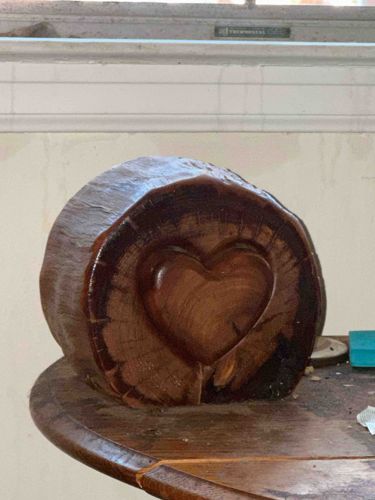
This appears to be a handcrafted wooden item, likely functioning as a hidden drawer puzzle box, informed by the additional context provided. The object is a single piece of wood, possibly a section of a tree trunk or a large branch, given its rounded, somewhat irregular cylindrical shape. It exhibits rich, dark brown tones, characteristic of natural, polished or varnished wood, with visible wood grain and growth rings at its 'ends.' One end features a deeply carved, stylized heart shape, which seems to be the focal point and a key element of its design. The heart is smoothly finished, contrasting slightly with the more rustic, natural bark-like texture visible on the exterior circumference, though this exterior also has a glossy, varnished appearance. The craftsmanship suggests a combination of natural wood form and deliberate carving and finishing. There are no obvious signs of significant damage, though some minor surface wear or dust is visible around its base where it rests on the table, typical for an item of this nature that might be handled or displayed. No specific maker's marks or signatures are discernible from the image. Its style suggests a more contemporary, perhaps folk art or artisanal creation, rather than a mass-produced item, possibly dating from the late 20th or early 21st century. The quality of the carving, particularly the smooth, consistent curve of the heart and the high-gloss finish, indicates skilled workmanship. The 'hidden drawer' aspect, while not visible externally in this single view, implies clever engineering and precision in its internal construction.
AI Appraisal Report
Upon examining the provided image and supporting details for the 'Wooden Heart Carved Hidden Drawer Puzzle Box,' I assess its condition as excellent, showing minimal signs of wear consistent with an item that has been handled and displayed. The rich, dark wood tones, visible grain, and high-gloss finish, particularly on the deeply carved heart, indicate skilled craftsmanship. Authenticity, based solely on visual inspection, suggests a handcrafted, artisanal piece, likely from the late 20th or early 21st century, rather than a mass-produced item. The smooth curves of the heart and the overall finish speak to a high level of woodworking expertise.
In terms of market conditions, similar handcrafted puzzle boxes or decorative wooden art pieces can vary widely in value. I've considered comparables in the folk art and artisan craft markets, where demand is for unique, well-executed pieces. The 'hidden drawer' aspect, though not visually confirmed, adds significant appeal and complexity, enhancing its perceived value as both a decorative object and an ingenious puzzle.
Factors significantly impacting value include the demonstrated skill in carving and finishing, the unique 'puzzle box' functionality, and the aesthetic appeal of its natural wood form combined with the carved heart motif. Rarity is moderate; while puzzle boxes are not uncommon, a piece of this specific aesthetic and apparent quality, handcrafted from a single wood piece, is less frequently encountered.
Limitations in authenticity verification from images alone are notable. A full authentication would necessitate a physical inspection to verify wood type, internal mechanism integrity, and confirm the absence of modern manufacturing marks. Provenance documentation, if available, detailing its maker or history of ownership, would also greatly enhance certainty regarding its origin and potential attribution to a known artisan or workshop. Scientific testing, such as carbon dating for the wood, is generally not warranted for items of this presumed age and value range but could further confirm its period if needed for high-value attribution.