AI Appraisal Estimate

AI-generated estimates · not official valuations

From the user

What was submitted

Photo and notes provided by the user — not generated by AI

Submitted item photo
Submitted photo · June 17, 2026

User's notes

Japan

AI analysis below

AI appraisal

AI analysis & estimate

AI-Generated · Verify before acting

Everything below is generated by AI for informational purposes only. AI can make mistakes — the AI may misidentify items or misattribute them (artist, maker, brand, designer, origin, era). This is not an official valuation and should not be used for insurance, sale, tax, estate, legal, or lending purposes — or any decision requiring a certified appraisal. It is not an authoritative claim about any person, brand, or rights holder — do not share or rely on it as a factual statement about a third party. Always consult qualified professionals before making financial decisions.

Note

This analysis also relies on unverified notes provided by the user, which may be incomplete or inaccurate and could affect the result.

Read the full disclaimer

AI Identification

·Not independently authenticated·Verify before acting

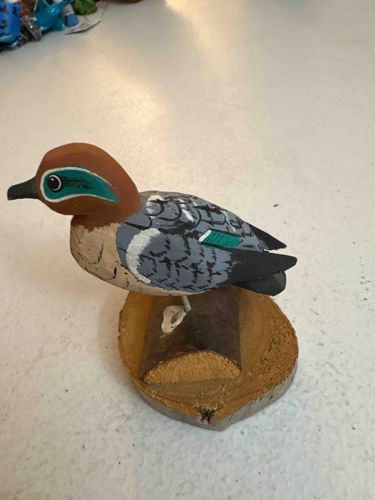
Japanese Hand-Carved Wooden Green-Winged Teal Duck Figurine

Decorative Arts / Wood Carvings

AI Estimated Value

·Not an official valuation·Verify before acting

$45 - $75

As of June 17, 2026

AI Item Analysis

·AI can make mistakes·Verify before acting
This item is a decorative hand-carved and hand-painted wooden figurine depicting a Green-winged Teal duck, likely originating from Japan as indicated by specific stylistic cues. The piece is constructed from multiple segments: a carved avian body, thin wire-like legs, and a naturalistic wooden base. The bird stands on a section of a small log, which is further mounted onto a circular cross-section slab of wood with visible bark. The bird's plumage is rendered with a matte polychrome finish, featuring a distinctive cinnamon-colored head with a vibrant green stripe extending from the eye. The body exhibits a grey and black scalloped pattern to represent feathers, accented with white and teal wing patches. In terms of condition, the paint shows slight age-related wear and minor surface dust, particularly in the crevices of the carving. The wood base displays natural drying cracks (checking), which is common for solid wood sections. The craftsmanship reflects a folk-art aesthetic, utilizing simplified geometric shapes to capture the essence of the species. This style is consistent with mid-to-late 20th-century Japanese bird carvings often sold as refined souvenirs or decorative art pieces. There are no clearly visible maker's marks from this angle, but the quality of the paint application suggests a skilled artisan hand.
AI Appraisal Report

·AI can make mistakes·Verify before acting
I have examined the digital representation and description of this hand-carved Green-Winged Teal duck figurine. My assessment identifies this as a mid-to-late 20th-century Japanese folk-art carving. The craftsmanship is consistent with the 'Kibori' tradition or refined 'Omiyage' (souvenir) craftsmanship from high-elevation woodworking regions of Japan. The polychrome application successfully captures the distinctive ocular stripe and speculum coloring of the species with a charming, stylized aesthetic. Condition-wise, the piece shows moderate age-appropriate wear. The checking (cracking) observed on the natural wood base is a result of moisture fluctuation in solid wood and is expected for such an item, though it slightly impacts the structural display quality. The paint remains largely intact, though surface dust and minor oxidation suggest a lack of high-end archival storage. This specific style of bird carving was produced in significant quantities for the domestic and export markets during the 1960s–1980s. While highly decorative, they are not currently rare, leading to a stable but modest secondary market value. Comparables for similar Japanese avian carvings typically sell in the $30 to $100 range depending on size and species. Limitations: This appraisal is based solely on visual inspection of images. Accurate authentication remains preliminary without a physical examination to check for artist signatures (hanko) often located on the underside of the base. To confirm historical significance, provenance documentation or a maker's mark would be required. In-person testing would involve examining the pigments under UV light to ensure no modern acrylic overpainting has occurred and checking the wood's density to confirm the specific species of timber used.

Get your items appraised

Instant estimates of your treasures with AI-powered appraisals

Browse More Appraisals