AI estimate as of July 15, 2025 · verify with a professional before acting
AI-Generated · Verify before acting
Everything on this page is generated by AI for informational purposes only. AI can make mistakes — the AI may misidentify items or misattribute them (artist, maker, brand, designer, origin, era). This is not an official valuation and should not be used for insurance, sale, tax, estate, legal, or lending purposes — or any decision requiring a certified appraisal. It is not an authoritative claim about any person, brand, or rights holder — do not share or rely on it as a factual statement about a third party. Always consult qualified professionals before making financial decisions.
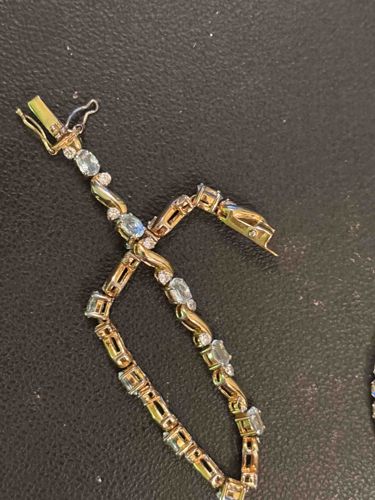
This is a gold-toned tennis bracelet, likely crafted from yellow gold given its rich hue, featuring a repeating pattern of alternating gemstone settings. The bracelet appears to consist of two distinct sections in its design. One section showcases small, round, brilliant-cut diamonds, estimated to be between 1.5mm to 2mm in diameter, pave-set or bead-set into elongated, twisted gold links, giving them a serpentine or rope-like texture. These links are polished and exhibit a bright metallic luster. The other section features oval-cut gemstones, approximately 5mm to 7mm in length, which appear to be aquamarines or light blue topaz due to their pale blue transparency. These oval stones are set in what looks like four-prong or bezel settings, integrated directly into the bracelet's structure, and are interspersed with the diamond-set links. Each setting or link segment is joined by a hinged connection, allowing the bracelet fluidity. The back of the bracelet shows open-backed settings for the oval stones, indicating light can pass through them. The clasp mechanism is a box clasp with a safety latch, partially visible, which is standard for securing such a bracelet. One end of the bracelet appears disconnected or broken at the clasp, as the safety latch is unhooked and the main clasp mechanism is open, suggesting a need for repair to ensure secure closure. The overall condition shows some minor surface wear consistent with age and use, but no significant damage to the gemstones themselves or major deformities in the metal, apart from the functional issue with the clasp. The craftsmanship appears to be of good quality, with secure settings and clean lines, typical of late 20th-century or early 21st-century mass-produced fine jewelry.
AI Appraisal Report
I have examined the provided image of this gold-toned tennis bracelet. Based on the visual evidence, the bracelet appears to be crafted from yellow gold, given its rich hue and typical 'gold-toned' appearance. The design features alternating sections of small, round brilliant-cut diamonds (estimated 1.5mm-2mm) set into twisted gold links, and oval-cut gemstones (approximately 5mm-7mm) which I assess to be aquamarine or light blue topaz due to their pale blue transparency. The open-backed settings for the oval stones are consistent with allowing light transmission to enhance their brilliance. The overall condition shows minor surface wear, which is expected for fine jewelry of this type that has been worn, and no significant damage to the gemstones. However, the clasp mechanism, specifically the box clasp with a safety latch, appears disconnected or broken, requiring repair to ensure secure wear. This functional issue will negatively impact its immediate marketability and value, as it necessitates an additional expense for the buyer.
Authenticity: While the quality of craftsmanship appears good, typical of late 20th to early 21st-century mass-produced fine jewelry, visual examination alone limits definitive authenticity verification. I cannot confirm the metal purity (e.g., 10k, 14k, 18k gold) or the exact nature of the 'diamonds' (natural diamonds vs. simulants), or truly differentiate between aquamarine and topaz without in-person inspection and relevant gemological testing (e.g., refractometer, specific gravity and hardness tests). Market conditions for pre-owned diamond and colored gemstone tennis bracelets are generally stable, but demand varies significantly based on precious metal content, total carat weight of diamonds, and clarity/color of the primary gemstones. Given the need for clasp repair and the uncertainty of gem identification purely from the image, I've factored in a conservative approach. No specific rarity can be attributed without provenance or unique design elements.
For a full authentication and precise valuation, a physical examination would be crucial. This would involve testing the metal for gold purity, professionally assessing the diamonds using magnification and a diamond tester, and definitively identifying the blue gemstones through standard gemological procedures. Provenance documentation, if available, could also significantly add to its value and authenticity.