AI estimate as of November 11, 2025 · verify with a professional before acting
AI-Generated · Verify before acting
Everything on this page is generated by AI for informational purposes only. AI can make mistakes — the AI may misidentify items or misattribute them (artist, maker, brand, designer, origin, era). This is not an official valuation and should not be used for insurance, sale, tax, estate, legal, or lending purposes — or any decision requiring a certified appraisal. It is not an authoritative claim about any person, brand, or rights holder — do not share or rely on it as a factual statement about a third party. Always consult qualified professionals before making financial decisions.
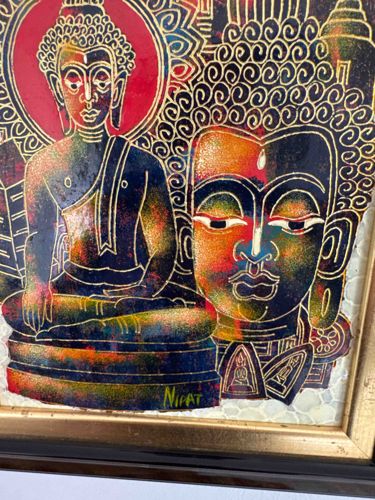
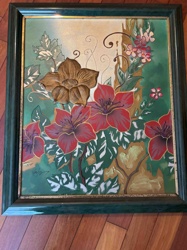
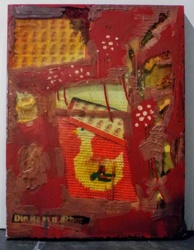
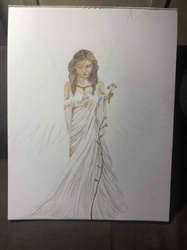
This item is a framed contemporary artwork depicting Buddha figures. The piece is characterized by its vibrant, multi-colored background, which appears to be applied with a spray-paint or airbrush technique, creating a mottled, iridescent effect across the surface. Overlaid on this colorful ground are outlines of Buddha figures executed in a metallic gold or bronze color, suggesting an etched, embossed, or paint-on-glass style.
One prominent Buddha figure is shown in a seated, meditative posture, likely the 'Bhumisparsha Mudra' (earth-touching gesture), with a distinct red halo or 'mandorla' behind its head. Its hair is depicted with tight, spiral curls, and its facial features are serene. To the right of the seated figure, a large, stylized Buddha head dominates the foreground, also outlined in gold with intricate spiral patterns for hair. This head displays strong, graphic lines for the eyes, nose, and mouth, with patches of contrasting colors.
Several smaller, intricately detailed amulet-like shapes are visible at the bottom right, also outlined in gold. The artwork is housed in a simple, possibly wooden frame with a gold-colored finish, showing some visible wear and minor chipping on its edges, consistent with age and handling. The overall aesthetic combines traditional Buddhist iconography with modern artistic techniques and a bold color palette, lending it an eclectic and striking appearance. The artist's signature 'NIPAT' is clearly visible in green script at the bottom left of the central seated Buddha figure. The backing behind the art appears to be textured or patterned, perhaps a linen mat or a decorative paper. The condition overall appears good, with no obvious damage to the artwork itself, beyond the frame's wear. The style suggests a contemporary Asian origin, likely from Southeast Asia, possibly Thailand, given the 'Nipat' signature and the specific iconography.
AI Appraisal Report
Upon examining the images of this framed contemporary Buddha artwork, my assessment leads to a fair market value in the range of $250 to $450. The piece presents a dynamic fusion of traditional Buddhist iconography with modern mixed-media techniques. The vibrant, spray-painted background and the metallic gold outlines of the Buddha figures create a visually striking effect. The artist's signature, 'NIPAT,' is clearly visible, suggesting a potential Thai origin, which aligns with the artwork's style. Artists named Nipat are known in the Thai contemporary art scene, though linking this specific work to a highly collected artist without further provenance is speculative.
The overall condition of the artwork appears good, with no visible damage to the piece itself. However, the gold-finished frame shows noticeable wear, including chipping and scuffs, which slightly detracts from its presentation and overall value. The market for contemporary Southeast Asian decorative art is active but can be price-sensitive for artists who are not internationally established. Similar works by emerging or regional artists often sell in this price range.
Several factors limit this appraisal. A definitive valuation is constrained by the inability to physically inspect the piece. An in-person examination would be required to confirm the medium (e.g., paint on glass, etching), assess the quality of materials, and examine the artist's signature more closely for authentication. Without provenance, sales records for 'NIPAT,' or a Certificate of Authenticity, definitively establishing the artist's identity and market history is impossible, which significantly impacts the potential for a higher valuation. The current value is based on its decorative appeal and apparent quality as a contemporary piece.