AI estimate as of August 17, 2025 · verify with a professional before acting
AI-Generated · Verify before acting
Everything on this page is generated by AI for informational purposes only. AI can make mistakes — the AI may misidentify items or misattribute them (artist, maker, brand, designer, origin, era). This is not an official valuation and should not be used for insurance, sale, tax, estate, legal, or lending purposes — or any decision requiring a certified appraisal. It is not an authoritative claim about any person, brand, or rights holder — do not share or rely on it as a factual statement about a third party. Always consult qualified professionals before making financial decisions.
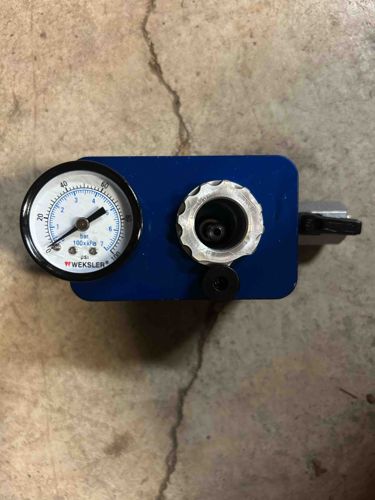
This item is a compact, rectangular pressure gauge assembly, likely designed for portable use or integration into a larger system. The main casing is a vibrant blue-colored metal, possibly anodized aluminum, indicative of durability and a professional finish. It appears to be approximately 6-8 inches in length given the visible components. On the left side, a circular pressure gauge is prominently displayed, featuring a black bezel and a white face. The gauge displays measurements in 'psi' (pounds per square inch) and 'bar / 100 x kPa' (pascals). The markings on the dial range from 0 to 60 psi and 0 to 4 bar/units, with clear numerical increments and smaller tick marks for precision readings. The brand name 'WEKSLER' is clearly visible at the bottom of the gauge face, indicating the manufacturer. The needle is black and currently points to zero, suggesting it's not under pressure or is properly calibrated at rest. To the right of the gauge, there's a large, knurled silver-toned metal fitting, suggesting a connection point for hoses or other equipment, likely for pressure input or output. This fitting has an internal bore that appears threaded or designed for a secure connection. Below this larger fitting, a smaller black cylindrical screw or knob is present, possibly for securing a component or adjusting a setting. On the far right edge, a black and silver component is partially visible, which could be another connection point, a handle, or a mounting bracket. The overall condition appears good with minimal signs of wear; there are no obvious dents, deep scratches, or significant corrosion visible on the blue casing or the metal fittings. The gauge face is clean and legible. The construction suggests a robust and functional piece of equipment, likely used for measuring gas or liquid pressure in various industrial, automotive, or HVAC applications. Its clean lines and legible markings indicate good craftsmanship.
AI Appraisal Report
Based on my visual examination of the Weksler Pressure Gauge Assembly, I assess its condition as very good. The vibrant blue casing shows no discernible dents or significant scratches, suggesting careful handling. The 'WEKSLER' branding on the clean, legible gauge face appears authentic, consistent with their known products. The needle resting at zero indicates proper calibration or no current pressure, which is a positive sign for functionality. The components, particularly the large knurled fitting, appear robust and well-maintained.
In terms of market conditions, Weksler gauges are well-regarded for their reliability in industrial and HVAC applications. Comparable new, compact pressure gauge assemblies of this quality often range from $150 to $300. Demand for such specialized testing equipment is generally stable among professionals and hobbyists, but it's not a rare item. Factors positively impacting value include the apparent unblemished condition and the reputable Weksler brand.
My primary limitation in this appraisal is the lack of a physical inspection. I cannot definitively verify the internal condition, gauge accuracy, or true functionality from an image alone. An in-person examination would allow for pressure testing, calibration verification, and a check for any internal material degradation. Provenance documentation, such as service records or original purchase receipts, would further confirm its authenticity and history. Without these, my assessment of authenticity is based solely on visual cues.