These notes were written by the person who submitted this item. Appraiser.AI has not verified them, and the AI's identification and estimate may rely on them.
AI Estimated Value
Not an official valuation
$5 - $15
AI estimate as of November 9, 2025 · verify with a professional before acting
AI-Generated · Verify before acting
Everything on this page is generated by AI for informational purposes only. AI can make mistakes — the AI may misidentify items or misattribute them (artist, maker, brand, designer, origin, era). This is not an official valuation and should not be used for insurance, sale, tax, estate, legal, or lending purposes — or any decision requiring a certified appraisal. It is not an authoritative claim about any person, brand, or rights holder — do not share or rely on it as a factual statement about a third party. Always consult qualified professionals before making financial decisions.
This analysis also relies on unverified notes provided by the user, which may be incomplete or inaccurate and could affect the result.
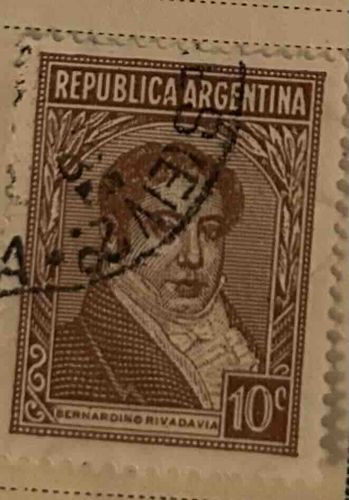
This item is a used postal stamp from Argentina, featuring a portrait of Bernardino Rivadavia, the first president of Argentina. The stamp is rectangular with perforated edges, indicative of its function as a postage stamp. Its primary colors are a rich brown and off-white/cream, executed in a monochromatic style. The image depicts a bust of Rivadavia, looking slightly to the right, rendered with fine line engraving that gives texture to his hair, ruffled cravat, and patterned coat. Above the portrait, the inscription 'REPUBLICA ARGENTINA' is clearly visible in a decorative serif font within a rectangular border. Below the portrait, 'BERNARDINO RIVADAVIA' is inscribed in a smaller, sans-serif font. In the bottom right corner, the denomination '10 C.' is prominently displayed within a square frame. The overall design suggests a classical or historical style, likely dating from the early to mid-20th century, a common period for such commemorative stamps. The stamp exhibits visible signs of use, including a clear, though partially obscured, cancellation mark that appears to be a date or numerical postmark in black ink, extending across the upper left and central portions of the portrait and the top inscription. The perforations are generally intact, although some minor wear or slight irregularities might be present around the edges, consistent with handling and removal from a sheet. The paper appears to be of standard stamp quality, with no significant tears or creases immediately discernible, suggesting it has been reasonably well-preserved despite its use.
AI Appraisal Report
Based on my visual examination of the provided image, the Bernardino Rivadavia 10 Centavos postal stamp appears to be an authentic example of its type, displaying characteristics consistent with Argentine stamps from the early to mid-20th century. The design, inscriptions, portrait style, and denomination are all typical for this series. The stamp shows clear signs of use, including a prominent cancellation mark, which, while obscuring some details, confirms its postal application. The perforations appear largely intact, and the paper quality seems standard, with no immediately discernible tears or deep creases. The monochromatic brown and off-white coloring is also consistent.
Market conditions for common, used issues of this type are generally modest. This particular stamp, while historically significant as it features Argentina's first president, is not considered rare in its used condition. Many millions were printed and issued. Comparables of similar used Rivadavia stamps typically trade in the low single to double-digit dollar range, depending on the clarity of the cancel and overall aesthetic appeal. Demand is steady among Argentine philatelists and general collectors, but not exceptionally high for a standard used example.
The primary factor impacting value is its used condition, with the cancellation mark slightly detracting from its visual prominence. If this were an unused (mint) example, especially with original gum (OG), the value would be significantly higher. Without an in-person physical inspection, I cannot definitively verify the absence of hidden faults, thin spots, repairs, or re-gumming. Full authentication for high-value stamps would require physical examination under magnification and potentially expert certification. For a common used stamp like this, however, the visible evidence strongly suggests authenticity and a value within the stated range.