AI identification & appraisal estimate

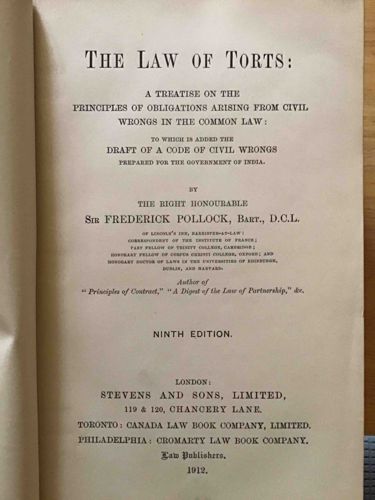
The Law of Torts, Ninth Edition by Sir Frederick Pollock

Submitted photo of The Law of Torts, Ninth Edition by Sir Frederick Pollock
Photo submitted by the user — not generated by AI

User's notes

Excellent condition

These notes were written by the person who submitted this item. Appraiser.AI has not verified them, and the AI's identification and estimate may rely on them.

AI Estimated Value

Not an official valuation

$100-150

AI estimate as of July 27, 2025 · verify with a professional before acting

AI-Generated · Verify before acting

Everything on this page is generated by AI for informational purposes only. AI can make mistakes — the AI may misidentify items or misattribute them (artist, maker, brand, designer, origin, era). This is not an official valuation and should not be used for insurance, sale, tax, estate, legal, or lending purposes — or any decision requiring a certified appraisal. It is not an authoritative claim about any person, brand, or rights holder — do not share or rely on it as a factual statement about a third party. Always consult qualified professionals before making financial decisions.

This analysis also relies on unverified notes provided by the user, which may be incomplete or inaccurate and could affect the result.

Read the full disclaimer

AI Item Analysis

This item is the title page of a legal textbook, specifically the 'Ninth Edition' of 'The Law of Torts: A Treatise on the Principles of Obligations arising from Civil Wrongs in the Common Law'. The book also includes 'The Draft of a Code of Civil Wrongs Prepared for the Government of India.' It was authored by 'The Right Honourable Sir Frederick Pollock, Bart., D.C.L.', who is also noted as the author of '“Principles of Contract,”' and '“A Digest of the Law of Partnership,”' etc. The publishing details indicate it was printed in London by 'Stevens and Sons, Limited,' located at '119 & 120, Chancery Lane.' Additional publishers include 'Canada Law Book Company, Limited' in Toronto, and 'Cromarty Law Book Company' in Philadelphia, identifying them as 'Law Publishers.' The publication year is clearly stated as 1912. The page appears to be made of off-white or cream-colored paper, showing a slight discoloration consistent with age, though the text itself is sharp and legible in black ink. The overall condition, based on the provided image, appears to be excellent, with no visible tears, folds, or significant foxing, suggesting the book has been well-preserved. The page exhibits a clean, classic typographic layout characteristic of early 20th-century legal publications, prioritizing clarity and authority.

AI Appraisal Report

Based on my examination of the provided image of the title page, this 'Ninth Edition' of 'The Law of Torts' by Sir Frederick Pollock, published in 1912, appears to be in excellent condition. The paper shows consistent aging discoloration, but the text is sharp and legible, with no visible tears, folds, or significant foxing. This suggests a very well-preserved example, which positively impacts its value. The classic typographic layout further adds to its appeal as a historical legal text. Authenticity, based solely on this image, seems high due to the clear publication details and established author and publishers; however, a full physical inspection would be needed to verify paper quality, binding integrity, and detect any potential restoration or missing pages not visible in a single image. Provenance documentation, if available, would further solidify its authenticity and history. Market demand for early 20th-century legal treatises, especially those by significant figures like Pollock, is generally moderate. While not exceedingly rare, a well-preserved edition like this is less common. Comparables for similar well-preserved academic legal texts from this era typically range from \$70 to \$150. The inclusion of 'The Draft of a Code of Civil Wrongs Prepared for the Government of India' adds a layer of historical interest. The factors significantly impacting value are its excellent condition and its author's renown within legal scholarship. Limitations in authenticity verification from images alone include inability to check internal condition, smell, paper texture, and full binding integrity; these would require in-person examination.

Keep exploring

More book appraisals

Get your items appraised

Instant AI-powered appraisal estimates from a photo

Browse More Appraisals