AI Appraisal Estimate

AI-generated estimates · not official valuations

From the user

What was submitted

Photo and notes provided by the user — not generated by AI

Submitted item photo
Submitted photo · July 7, 2026

User's notes

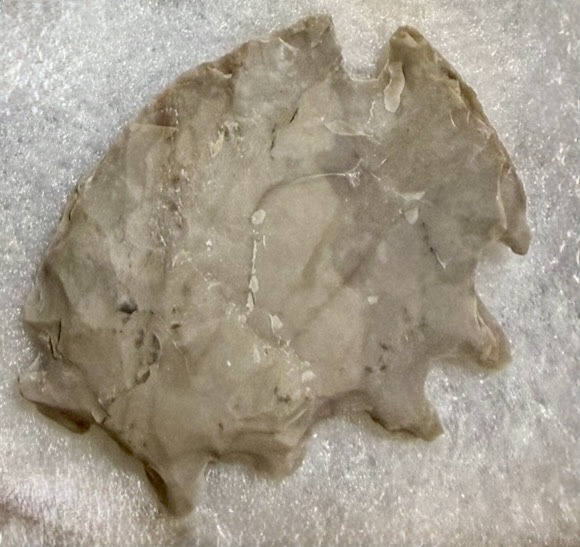
Ancient Buffalo Native American effigy

AI analysis below

AI appraisal

AI analysis & estimate

AI-Generated · Verify before acting

Everything below is generated by AI for informational purposes only. AI can make mistakes — the AI may misidentify items or misattribute them (artist, maker, brand, designer, origin, era). This is not an official valuation and should not be used for insurance, sale, tax, estate, legal, or lending purposes — or any decision requiring a certified appraisal. It is not an authoritative claim about any person, brand, or rights holder — do not share or rely on it as a factual statement about a third party. Always consult qualified professionals before making financial decisions.

Note

This analysis also relies on unverified notes provided by the user, which may be incomplete or inaccurate and could affect the result.

Read the full disclaimer

AI Identification

·Not independently authenticated·Verify before acting

Worked stone object in the style of a lithic effigy

Stone Artifacts

AI Estimated Value

·Not an official valuation·Verify before acting

$100 - $350

As of July 7, 2026

AI Item Analysis

·AI can make mistakes·Verify before acting
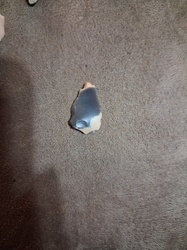
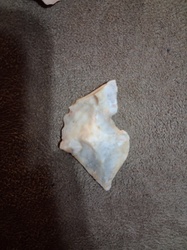
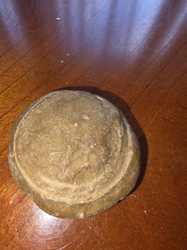
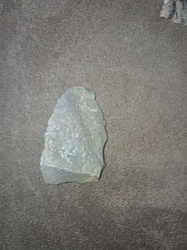
This item appears to be a worked stone object, exhibiting a shape that is stylistically consistent with zoomorphic figures, potentially resembling a quadruped animal. The object is composed of a fine-grained lithic material, appearing to be chert or flint, with a variegated tan and gray color palette. The surface displays evidence of conchoidal fracturing and pressure flaking along various edges, suggestive of manual reduction. The silhouette features several protrusions along the lower and side margins which could be interpreted as limbs or physiological features. The user-supplied identification of this item as an 'Ancient Buffalo Native American effigy' remains unverified, as the age and cultural origin cannot be established from imagery alone. Without physical inspection by a lithics expert or archaeologist to analyze micro-wear patterns, patination, and manufacturing techniques, it is impossible to determine if the piece is an ancient artifact, a more recent creation, or a naturally formed work that has undergone minimal modification. The piece shows various flake scars and indentations, with surface textures that appear relatively smooth between the worked margins. No maker's marks, signatures, or inscriptions are visible on the displayed side.
AI Appraisal Report

·AI can make mistakes·Verify before acting
Based on my visual analysis of the provided image, this object exhibits characteristics of a lithic effigy, showing manual reduction techniques such as pressure flaking on a fine-grained stone like chert. The user-supplied identification suggests this is an 'Ancient Buffalo Native American effigy.' While the silhouette is stylistically consistent with zoomorphic figures found in North American lithic traditions, I must treat this attribution as a hypothesis. I can observe conchoidal fracturing and a variegated patina, but I cannot verify from a photo whether these features result from ancient weathering or modern manufacture. The value estimate of $100 to $350 is based on the assumption that the item is a legitimate pre-contact artifact of moderate rarity. Native American lithic effigies are highly collectible, though the market distinguishes heavily between items with documented provenance and those found 'in the field.' To confirm this hypothesis, a physical inspection by a lithics expert or archaeologist is required to analyze micro-wear patterns and patination depth under magnification, as well as an evaluation of any available provenance documentation. If this item were determined to be a modern creation or an 'in the style of' reproduction using contemporary tools, the market value would likely decrease significantly, typically falling into the $20 to $50 range as a decorative or educational piece. Conversely, if physical analysis and historical documentation were to support a specific cultural origin and age, the value could potentially exceed this estimate. The current valuation reflects the uncertainty inherent in identifying unprovenanced stone tools from imagery alone, where natural geofacts or modern replicas can often mimic ancient flaking patterns.

Get your items appraised

Instant estimates of your treasures with AI-powered appraisals

Browse More Appraisals