AI estimate as of November 2, 2025 · verify with a professional before acting
AI-Generated · Verify before acting
Everything on this page is generated by AI for informational purposes only. AI can make mistakes — the AI may misidentify items or misattribute them (artist, maker, brand, designer, origin, era). This is not an official valuation and should not be used for insurance, sale, tax, estate, legal, or lending purposes — or any decision requiring a certified appraisal. It is not an authoritative claim about any person, brand, or rights holder — do not share or rely on it as a factual statement about a third party. Always consult qualified professionals before making financial decisions.
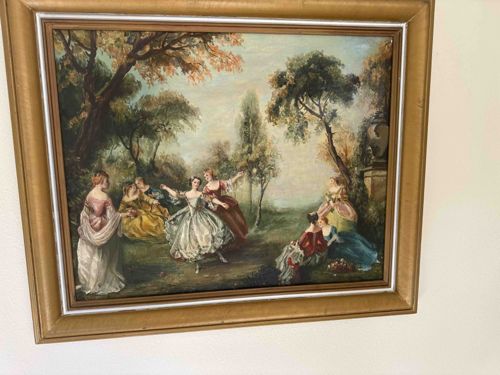
This item is an oil painting, likely on canvas, depicting a 'fête galante' scene with multiple elegantly dressed figures dancing and conversing in a lush park setting. The overall dimensions appear to be medium to large, suitable for display on a wall. The color palette is rich and somewhat muted, featuring earthy greens and browns for the foliage, with vibrant blues, yellows, whites, and reds for the figures' attire, rendered in a style reminiscent of 18th-century European art, particularly the Rococo period. The female figures are clad in flowing gowns with ruffled and draped details, suggesting period costuming. One central figure in a light blue or white dress is actively dancing, encircled by several others. Two figures are seated in the foreground to the right, engaging in conversation or observation. The background features mature trees with autumnal or late summer foliage, and architectural elements like a classical urn on a pedestal are partially visible, suggesting an aristocratic garden or estate. The brushwork appears somewhat loose but refined, characteristic of oil painting. The painting is housed within a gilded wooden frame that features a simple, slightly textured gold-tone finish and a thinner silver-colored inner fillet. The frame itself shows minor signs of wear consistent with age, such as slight scuffs, but no significant damage appears visible to the painting surface itself from the provided images. The condition of the canvas or panel beneath the paint is not discernible, nor are any signatures or maker's marks visible. The style suggests it could be an antique or a reproduction/homage piece from a later period (e.g., 19th or 20th century) emulating the 18th-century aesthetic. The quality of execution appears to be good, with attention to detail in drapery and expressive poses, indicative of a skilled hand.
AI Appraisal Report
Based on my visual examination of the provided image, this Fête Galante style oil painting depicts a lively park scene with elegantly dressed figures. The composition, subject matter, and color palette strongly evoke the Rococo period of the 18th century. The brushwork appears loose yet refined, indicative of a skilled hand. The painting itself seems to be in good condition, with no visible significant damage to the paint surface. The gilded wooden frame, while showing minor scuffs consistent with age, presents the artwork well.
Authenticity is a key factor here. While the style is clearly an homage to 18th-century Fête Galante, determining if it is a period piece or a later reproduction (e.g., 19th or early 20th century) is crucial for value. Without in-person examination, I cannot definitively confirm its age or authenticity.
Market conditions for works in this style are generally stable, with demand for well-executed decorative pieces. Reproductions or works 'in the style of' the Rococo period, while not fetching the prices of authenticated period masters, still hold value, especially if they are of good quality. The size (assumed medium to large) and aesthetic appeal contribute positively to its marketability. The apparent quality of execution and attention to detail suggest it could be more than just a decorative reproduction, possibly a skilled interpretation or even an earlier historical work.
To provide a full and accurate authentication, an in-person examination would be required to assess the canvas, stretcher, paint layers for age and materials using techniques such as UV light examination, pigment analysis, and cross-section analysis. Research into provenance documentation, if available, would also be invaluable. Without a signature or attribution, this appraisal is based purely on stylistic analysis and assumes a good quality decorative piece from the late 19th or early 20th century, or a skillful homage to the 18th century, rather than an authenticated original 18th-century masterwork. If it were proven to be a genuine 18th-century piece by a notable artist, the value would, of course, be significantly higher.