These notes were written by the person who submitted this item. Appraiser.AI has not verified them, and the AI's identification and estimate may rely on them.
AI Estimated Value
Not an official valuation
$15 - $30
AI estimate as of August 10, 2025 · verify with a professional before acting
AI-Generated · Verify before acting
Everything on this page is generated by AI for informational purposes only. AI can make mistakes — the AI may misidentify items or misattribute them (artist, maker, brand, designer, origin, era). This is not an official valuation and should not be used for insurance, sale, tax, estate, legal, or lending purposes — or any decision requiring a certified appraisal. It is not an authoritative claim about any person, brand, or rights holder — do not share or rely on it as a factual statement about a third party. Always consult qualified professionals before making financial decisions.
This analysis also relies on unverified notes provided by the user, which may be incomplete or inaccurate and could affect the result.
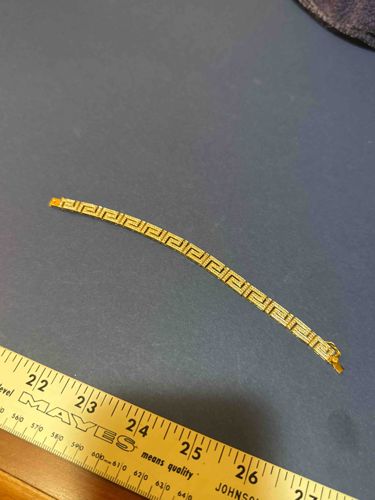
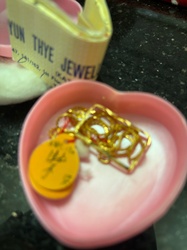
This is a gold-toned bracelet, approximately 7 inches in length as indicated by the user-provided context. The design of the bracelet features a repetitive Greek Key or meander pattern, a stylized motif that is common in classical and neo-classical designs. Each segment of the pattern appears to be formed by interlocking rectangles, creating a continuous band. Some portions of the pattern, specifically the raised parts of the Greek Key, seem to be accented with small, perhaps pavé settings or textured surfaces that give a sparkling or granular appearance, suggesting the presence of small stones (possibly cubic zirconia or diamond simulants) or a granular finish. The bracelet is constructed of multiple small links connected to form a flexible, wearable piece. The color is a bright, uniform gold, suggesting either a high-karat gold alloy, gold plating, or gold-filled material. The clasp, visible at one end, appears to be a basic lobster claw or similar closure, though specific details are not fully discernible from the image quality. The overall condition appears good, with no obvious signs of significant wear, tarnish, or missing elements, though a closer inspection would be needed to confirm the integrity of the settings or finish. The bracelet's style suggests a contemporary or modern classic aesthetic. The craftsmanship seems detailed, particularly in the formation of the meander pattern. No specific maker's marks or signatures are visible, and without further information or higher resolution images, it is difficult to ascertain the exact material composition or manufacturing origin beyond the 'china' context given, which may refer to a material or origin. The style period is likely 20th to 21st century given the general design tropes and manufacturing techniques.
AI Appraisal Report
Upon visual examination of this Greek Key motif bracelet, I assess it to be a contemporary fashion jewelry piece. The design features a continuous meander pattern, a popular classical revival style. The provided information, '7 inch bracelet china', strongly suggests it was mass-produced in China. The 'gold-toned' description, coupled with the likely origin, indicates the material is a base metal alloy with gold plating, rather than solid gold. The small, sparkling accents are presumed to be cubic zirconia or a similar simulant. The overall condition appears good from the image, with the clasp and links intact and no visible signs of significant wear or tarnish to the plating. The market for such non-precious metal fashion jewelry is driven by style rather than intrinsic material value. Comparable gold-plated, Chinese-made Greek Key bracelets are widely available in the primary and secondary markets, creating a high supply and limiting rarity. Its value is therefore modest, reflecting its status as a decorative accessory. To issue a definitive appraisal, a physical examination would be necessary to test the metal composition using an XRF spectrometer or acid test, identify the stones with a thermal conductivity tester, and examine the piece for any maker's marks under a jeweler's loupe. Without such tests, I cannot authenticate the materials beyond a visual assessment, and the valuation is based on the assumption that it is a non-precious fashion item.