AI estimate as of August 14, 2025 · verify with a professional before acting
AI-Generated · Verify before acting
Everything on this page is generated by AI for informational purposes only. AI can make mistakes — the AI may misidentify items or misattribute them (artist, maker, brand, designer, origin, era). This is not an official valuation and should not be used for insurance, sale, tax, estate, legal, or lending purposes — or any decision requiring a certified appraisal. It is not an authoritative claim about any person, brand, or rights holder — do not share or rely on it as a factual statement about a third party. Always consult qualified professionals before making financial decisions.
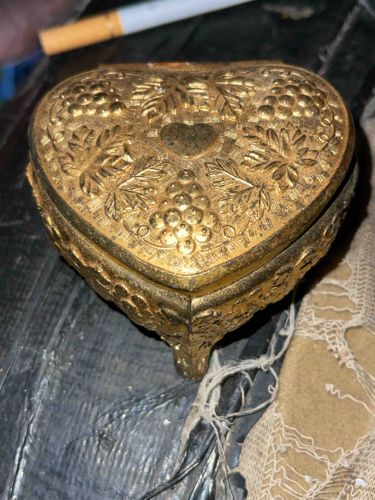
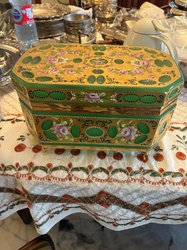
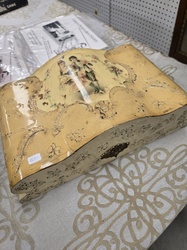
This is a vintage heart-shaped trinket or jewelry box, likely constructed from a metal alloy such as brass or spelter, with a gold-tone finish. Its dimensions appear to be small, suitable for holding rings, earrings, or other precious keepsakes. The entire exterior is heavily embossed with a repeating pattern of grape clusters and intertwining grape leaves, characteristic of a classical or perhaps Art Nouveau-inspired design. A notable feature is a prominent heart emblem impressed into the center of the lid, surrounded by radiating lines that enhance its focal point. The box stands on four small, decorative feet, which are also embossed, raising it slightly from the surface. The gold finish exhibits significant areas of patina and darkening, particularly within the recessed areas of the embossing, suggesting age and oxidation. There are visible signs of wear, including some dulling of the original luster and possibly some superficial scratches, consistent with an item that has been handled and used over time. The craftsmanship, indicated by the detailed embossing, suggests a manufactured piece, possibly mass-produced, but with good attention to ornamental detail. There are no discernible maker's marks or signatures visible in the image, making precise manufacturing details difficult to ascertain. Based on the style and apparent wear, it likely dates from the mid-20th century, possibly the 1950s to 1970s. The overall condition, while showing age, appears stable with no obvious significant damage such as dents or cracks, though a thorough inspection would require handling the item.
AI Appraisal Report
Upon examining the Vintage Heart-Shaped Embossed Gold-Tone Trinket Box, I note its good overall condition, albeit with expected signs of age. The patina and darkening within the embossed grape and leaf pattern, along with the dulling of the gold luster, are consistent with mid-20th century metal items. While the detailed embossing suggests good craftsmanship, the lack of maker's marks, which is common for such decorative items from this period, limits precise manufacturing attribution. Authenticity based on visual examination alone indicates it is likely an original vintage piece, not a modern reproduction.
Market conditions for vintage trinket boxes are generally stable for decorative items. Comparable sales of similar embossed metal trinket boxes from the 1950s-1970s, particularly those without precious metal content or famous makers, typically fall into the modest collectible range. Demand for these items is driven by their decorative appeal and nostalgic value rather than rarity; similar pieces are not uncommon. Factors impacting its value negatively are the absence of a known maker, the base metal construction (likely brass or spelter, not solid gold), and its primarily decorative function. Its condition, while not pristine, is acceptable for its age and type.
Limitations in authenticity verification from images alone are significant. I cannot definitively ascertain the precise metal composition, internal condition (e.g., lining, hinge integrity), or detect any subtle repairs or hairline cracks without physical inspection. A thorough in-person examination would allow for tactile assessment of the metal, inspection of the hinge mechanism, and the possibility of discovering obscured marks. Provenance documentation would be ideal but is rarely available or necessary for items of this value. Scientific testing, such as XRF analysis for metal composition, would confirm material but is not warranted for an item of this type and estimated value.