AI estimate as of October 6, 2025 · verify with a professional before acting
AI-Generated · Verify before acting
Everything on this page is generated by AI for informational purposes only. AI can make mistakes — the AI may misidentify items or misattribute them (artist, maker, brand, designer, origin, era). This is not an official valuation and should not be used for insurance, sale, tax, estate, legal, or lending purposes — or any decision requiring a certified appraisal. It is not an authoritative claim about any person, brand, or rights holder — do not share or rely on it as a factual statement about a third party. Always consult qualified professionals before making financial decisions.
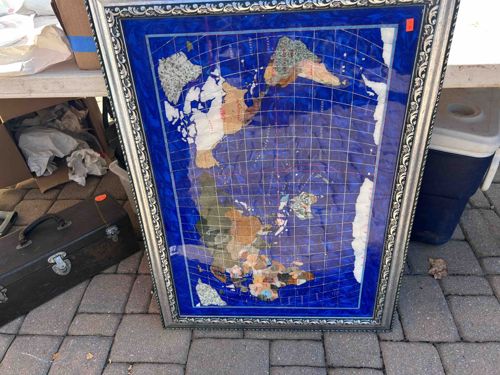
This item is a framed decorative art piece depicting a world map, crafted from what appears to be various types of natural stone, with a prominent use of deep blue lapis lazuli for the oceans. The map itself features landmasses composed of different colored stones, possibly including marble, jasper, or other mineral aggregates, cut and inlaid to represent the continents. The craftsmanship involves a mosaic or marquetry technique, where individual stone pieces are fitted together to form the image. A grid of longitude and latitude lines is visible over the blue 'ocean' areas, likely etched or inlaid with a thin metallic or lighter-colored material, adding a cartographic detail. The entire stone inlay is housed within a substantial, ornate silver-colored frame. The frame has a classic, decorative profile with raised scrollwork or floral motifs along its inner and outer edges, suggesting a traditional or possibly neoclassical style. The finish of the frame appears metallic, possibly a painted or plated wood or resin, with some reflective quality. The visible condition suggests the item is generally well-preserved, though a red tag is attached to the upper right corner of the frame, possibly indicating a price or an auction lot number. The artwork likely dates from the mid-to-late 20th century, a period when such stone map art was popular, often produced in Italian or Asian workshops. The quality of the stone cutting and inlay work appears to be relatively high, with intricate details for the coastlines and grid. There are no obvious signs of significant damage or repairs from the provided image, though without closer inspection, minor wear or lifting of stone segments cannot be entirely ruled out.
AI Appraisal Report
Upon visual examination of the provided image, this framed Lapis Lazuli and Mixed Stone World Map Art appears to be a well-executed example of decorative stone inlay work. The use of deep blue lapis lazuli for the oceans is a key feature, suggesting a higher quality material choice, while the various colored stones for the landmasses add visual interest. The craftsmanship of the mosaic or marquetry technique, particularly the intricate coastlines and etched grid lines, seems to be of good standard. The ornate silver-colored frame, with its classic motifs, complements the piece and enhances its decorative appeal. Its condition appears generally good, with no obvious major damage visible, although the red tag is noted.
Based on current market conditions for comparable stone world map art, particularly those featuring significant lapis lazuli, such pieces typically fetch values in the mid-to-high hundreds. Factors affecting value include the quality of the stone cutting, the specific types of stone used beyond lapis lazuli, and the overall condition. These maps tend to have consistent demand as decorative items for offices or traditional interiors, but they are not exceptionally rare.
Limitations in authenticity verification from images alone are significant. While the piece presents well visually, I cannot definitively assess if all stones are natural, their precise type, or rule out previous repairs or restoration. An in-person examination would be crucial to verify the integrity and type of all stone inlays, check for any lifting or chipping of segments, and to determine the frame's material and construction quality. Provenance documentation, if available, would help establish its origin and age more precisely, differentiating between Italian or Asian workshops which can sometimes impact market perception. Microscopic analysis could confirm stone types and any treatments. Without physical inspection, the appraisal value is based on the assumption of sound condition and genuine materials consistent with the visual cues.