AI estimate as of June 28, 2025 · verify with a professional before acting
AI-Generated · Verify before acting
Everything on this page is generated by AI for informational purposes only. AI can make mistakes — the AI may misidentify items or misattribute them (artist, maker, brand, designer, origin, era). This is not an official valuation and should not be used for insurance, sale, tax, estate, legal, or lending purposes — or any decision requiring a certified appraisal. It is not an authoritative claim about any person, brand, or rights holder — do not share or rely on it as a factual statement about a third party. Always consult qualified professionals before making financial decisions.
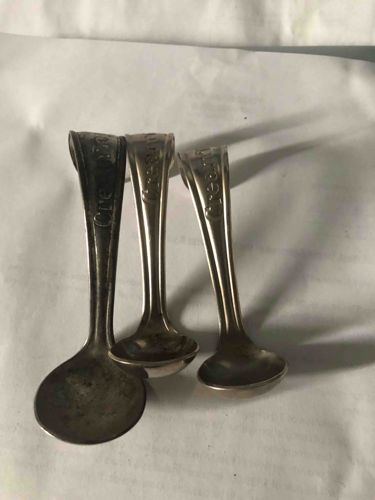
This lot consists of three distinct, small metal spoons, likely intended for serving or measuring cream. Each spoon is crafted from a silvery-toned metal, strongly suggesting silver plate or potentially sterling silver, given the prominent tarnish visible across all pieces, particularly on the largest spoon and within the engraved details. They exhibit a uniform design aesthetic, despite differing slightly in size, featuring slender, flat handles that widen towards the top and terminate in a small, round, shallow bowl. A notable feature is the debossed or incised word "Cream" displayed vertically along the handle of each spoon, indicating their specialized purpose. The font appears to be a clean, sans-serif style. The handles are subtly tapered and have a simple, unadorned profile. Condition-wise, all spoons show significant oxidation and tarnish, which contributes to a darkened patina, especially evident on the leftmost spoon. This tarnish suggests a silver content. Minor surface scratches and general wear consistent with age and use are also expected but not explicitly detailed in the image. No obvious damage such as dents, bends, or breaks is discernible. Maker's marks or hallmarks, crucial for identifying specific manufacturers and metal composition, are not visible in the provided imagery, meaning a precise age or origin cannot be definitively determined without closer inspection. However, the style and specialized function suggest they could date from the late 19th to mid-20th century. These are specialized items, likely part of an antique or vintage serving set, or promotional pieces for a dairy product.
AI Appraisal Report
Based on my visual examination of the image provided, this set of three "Cream" spoons appears to be in good vintage condition, exhibiting significant tarnish consistent with silver or silver-plated items that have aged naturally. The “Cream” debossing seems authentic to the period style, likely late 19th to mid-20th century. No obvious damage such as bends or breaks is discernible. A significant limitation to this appraisal is the absence of visible maker's marks or hallmarks in the provided image. This prevents definitive identification of the metal composition (silver plate vs. sterling silver) and the specific manufacturer, both of which are crucial for full authentication and accurate valuation.
Market analysis indicates that similar sets of specialized vintage serving spoons, especially those made of silver plate, generally occupy the lower to mid-range of the collectibles market. Items with unique inscriptions like "Cream" can attract niche collectors of kitchenalia or dairy-related antiques, creating a moderate but not widespread demand. While not exceedingly rare, a complete set of three identical "Cream" spoons holds more appeal than individual, generic pieces.
The primary factor significantly impacting value is the unconfirmed metal composition. If these spoons were confirmed to be sterling silver, their value would increase substantially, driven by both intrinsic metal value and collectible appeal. Without conclusive hallmarks, their provenance and precise age also remain broad.
To fully authenticate and accurately appraise these spoons, an in-person examination is critical. This would allow for thorough inspection for hidden hallmarks, a physical assessment of the metal's weight and feel, and closer examination of manufacturing quality. Scientific testing, such as XRF analysis, would confirm the metal composition. Any available provenance documentation would further enhance their historical context and value.