AI estimate as of September 27, 2025 · verify with a professional before acting
AI-Generated · Verify before acting
Everything on this page is generated by AI for informational purposes only. AI can make mistakes — the AI may misidentify items or misattribute them (artist, maker, brand, designer, origin, era). This is not an official valuation and should not be used for insurance, sale, tax, estate, legal, or lending purposes — or any decision requiring a certified appraisal. It is not an authoritative claim about any person, brand, or rights holder — do not share or rely on it as a factual statement about a third party. Always consult qualified professionals before making financial decisions.
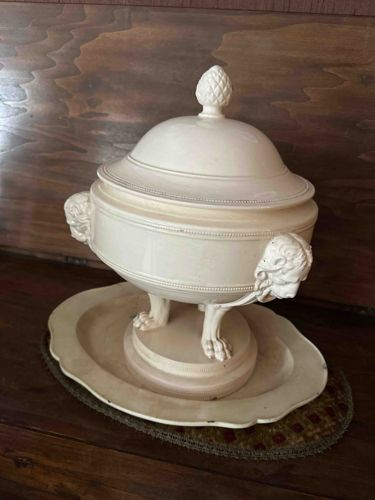
This is a white, possibly ceramic or stoneware, tureen with an accompanying underplate, exhibiting a Neoclassical or Empire style aesthetic. The tureen itself is ovular in shape, featuring a domed lid topped with an ornate finial styled as a stylized pineapple or acanthus bud, a common motif signaling hospitality and welcome. The body of the tureen is supported by four robust, sculptural feet resembling animal paws (possibly lion's paws), typical of classical influence. Two prominent handles, sculpted into detailed lion's heads, adorn the sides of the tureen, adding to its regal and grand appearance. There are decorative bands with what appears to be beading or a reeded pattern encircling the rim of the tureen and also the base of the lid. The underplate is also ovular, with a gently scalloped or undulating edge, designed to catch any drips from the tureen and complete the formal presentation. The overall color is an off-white or cream, suggesting an aged appearance or intentional 'biscuit' finish without a glossy glaze, or perhaps a matte glaze. The condition appears good, with some visible patina or discoloration, particularly around the edges and recessed areas, suggesting age and use without obvious signs of severe damage like chips or cracks. The craftsmanship appears to be of good quality, with attention to sculptural detail in the lion heads, feet, and finial. The style points toward an approximate age from the late 19th to early 20th century, though revivals of classical styles can extend its potential manufacturing period. No specific maker's marks or signatures are discernible from the provided image.
AI Appraisal Report
Upon visual examination of the provided image, this Neoclassical Style tureen and underplate appears to be a well-crafted piece. The off-white, possibly ceramic or stoneware, material with its matte finish suggests either an unglazed 'biscuit' ware or a matte glaze, consistent with styles from the late 19th to early 20th century. My assessment of the condition is good; while there is visible patina and some discoloration, indicating age and use, I observe no overt chips, cracks, or repairs. The sculptural details, such as the lion's head handles, paw feet, and pineapple finial, are distinct and suggest good quality manufacture. While the Neoclassical/Empire style is generally steady in demand, this specific type of serving ware has a more niche market today compared to functional tableware. Comparables for unglazed or matte finished tureens of this period, without specific maker's marks, typically fall within the mid-hundreds range. Factors impacting value positively include the intricate detailing and good preservation. Conversely, the lack of a known manufacturer and the somewhat limited modern utility of a large tureen moderate its top-end value. Demand for decorative antique serveware is present, especially for pieces with strong aesthetic appeal and good condition, but it is not considered exceptionally rare. It is crucial to note that this appraisal is based entirely on the visual information from the image. For full authentication and a more definitive appraisal, an in-person examination would be required to verify the material composition (e.g., stoneware vs. porcelain), confirm the absence of subtle damages or repairs, and search for any faint or hidden maker's marks that are not discernible in the photograph. Provenance documentation, if available, could significantly enhance value by confirming origin or historical significance.