AI estimate as of September 22, 2025 · verify with a professional before acting
AI-Generated · Verify before acting
Everything on this page is generated by AI for informational purposes only. AI can make mistakes — the AI may misidentify items or misattribute them (artist, maker, brand, designer, origin, era). This is not an official valuation and should not be used for insurance, sale, tax, estate, legal, or lending purposes — or any decision requiring a certified appraisal. It is not an authoritative claim about any person, brand, or rights holder — do not share or rely on it as a factual statement about a third party. Always consult qualified professionals before making financial decisions.
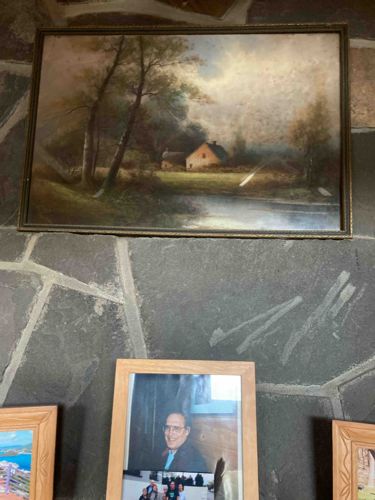
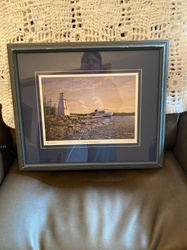
This item is a framed landscape painting, likely an oil or acrylic on canvas or board, depicting a bucolic scene. The primary colors in the painting are muted greens, browns, and blues, suggesting a temperate climate or a specific time of day like dawn or dusk, possibly overcast. The central elements of the composition include a small, light-colored house with a dark roof nestled within a forest or dense tree line on the left side, and a calm body of water, presumably a river or lake, that runs horizontally across the lower third of the canvas, reflecting the sky and surrounding foliage. There are prominent dark-trunked trees with sparse foliage on the left foreground, framing the scene. The sky above is a blend of pale blues and grays, indicating a cloudy or hazy atmosphere, with some lighter patches suggesting diffused lightBreaking through. A lighter, almost linear streak horizontally across the water to the right of the house might represent a reflection or a stylistic element. The painting is housed within a simple, narrow, rectangular frame with a metallic, possibly gilded or bronzed, finish and some decorative texturing, which shows signs of age and perhaps a slight patina. The overall condition appears to be fair to good, with some surface dust or slight discoloration visible, consistent with an older artwork that has been displayed over time. The style appears to be traditional or academic, possibly dating from the late 19th to mid-20th century, leaning towards realism with a soft, somewhat impressionistic touch in the rendering of light and atmosphere. No distinct artist's signature or maker's marks are visible in the provided image.
AI Appraisal Report
Based on my visual examination of the Framed Landscape Painting with House and River, the condition appears fair to good. There's visible surface dust or slight discoloration, which is typical for an older displayed artwork. The frame shows age and patina but seems intact. Authenticity, based solely on the image, is difficult to ascertain regarding the artist, but the style is consistent with traditional or academic landscape painting from the late 19th to mid-20th century. The soft, somewhat impressionistic characteristics suggest it could be a competent amateur or minor regional artist’s work.
Market conditions for unsigned landscape paintings of this type are generally modest. While decorative, without an identified artist or significant provenance, the value is primarily in its aesthetic appeal as a home decor item. Comparable sales of similar decorative, unsigned oil or acrylic landscape paintings typically fall within the $150-$500 range, depending on size, artistic quality, and framing. Demand for such pieces is steady but not high-end; rarity is not a significant factor here as this style of landscape is common.
Factors impacting its value include the lack of a visible signature, which significantly limits its potential as a collectible artwork. Its decorative appeal is its main driver. For a full authentication, including identifying the artist, an in-person examination would be crucial to look for obscured signatures, examine brushwork and paint application closely, and assess the canvas/board type and stretcher. Provenance documentation, such as purchase receipts or exhibition history, would also be essential. Scientific testing, like pigment analysis or UV light examination, could confirm age and detect restorations, but generally isn't cost-effective for pieces in this value range unless an attributed artist is suspected.