AI estimate as of October 16, 2025 · verify with a professional before acting
AI-Generated · Verify before acting
Everything on this page is generated by AI for informational purposes only. AI can make mistakes — the AI may misidentify items or misattribute them (artist, maker, brand, designer, origin, era). This is not an official valuation and should not be used for insurance, sale, tax, estate, legal, or lending purposes — or any decision requiring a certified appraisal. It is not an authoritative claim about any person, brand, or rights holder — do not share or rely on it as a factual statement about a third party. Always consult qualified professionals before making financial decisions.
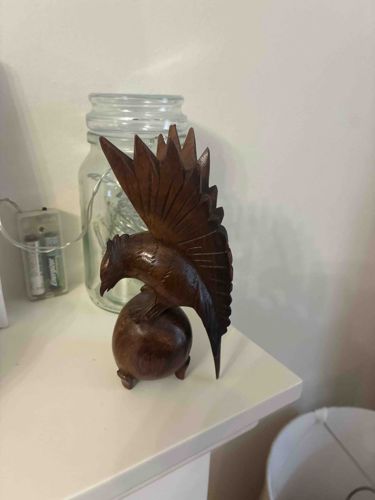
This item is a decorative sculpture crafted from dark, possibly stained, wood, depicting an eagle or bird of prey perched upon a spherical base. The overall color is a rich, deep brown, showcasing the natural grain of the wood. The eagle is captured in a dynamic pose, with its head slightly bowed, beak pointing downwards, and wings partially spread upwards and backwards. The wings feature individually carved feathers, indicated by distinct vertical grooves, giving them a textured and somewhat stylized appearance rather than a smooth, realistic rendition. The body of the bird is smoothly carved, suggesting a streamlined form. It appears to be grasping the spherical base with its talons, which are subtly integrated into the design. The spherical base itself rests on what appears to be three small, curved feet or supports, elevating it slightly from the surface. The carving exhibits good craftsmanship, with smooth lines and deliberate details, especially in the feathering of the wings. There are no obvious signs of significant damage such as cracks or major chips visible from this angle. The wood has a visible sheen, indicating a polished or varnished finish, which contributes to its rich color. This piece likely dates from the mid to late 20th century, a popular period for carved wooden figures. The absence of specific maker's marks or signatures prevents more precise manufacturing details. Its form factor suggests it is intended as a tabletop or shelf decoration. The overall condition appears to be good, with a well-maintained patina consistent with its age.
AI Appraisal Report
Based on my visual examination of the provided image, this carved wooden eagle on a sphere sculpture appears to be in good condition. The rich, dark brown wood exhibits a well-maintained polished or varnished finish consistent with its likely age. I observe no significant damage such as cracks or major chips. The carving, while detailed in the wings, has a stylized rather than hyper-realistic quality. The absence of specific maker's marks or signatures, which cannot be verified via image alone, limits a precise authentication of the carver or origin. Based on its aesthetic and carving style, I would place its manufacture in the mid to late 20th century, a period when such decorative wooden figures were popular.
Market conditions for decorative wooden sculptures of this nature are generally moderate. While well-crafted, this type of item is not exceedingly rare. Comparable pieces, often found in antique malls, online marketplaces, or estate sales, typically retail in the $75 to $250 range depending on size, wood quality, and carving intricacy. The 'eagle on sphere' motif is a common design, further contributing to its average rarity. Factors impacting value include the good overall condition and the appealing dark wood finish. However, the lack of known provenance, artist signature, or unique design elements prevents it from commanding a higher value.
Authenticity verification relies heavily on physical examination to assess wood type, carving techniques, and any subtle aging indicators not visible in an image. In-person inspection would allow me to check for repairs, confirm the specific type of wood used, and search for any obscured marks. Documentation of provenance, if available, would significantly enhance its value by connecting it to a specific artist or history.